
 CN/中国
CN/中国  US/USA
  KR/Korea
  DE/Germany
  ES/Spain
 VN/Việtnam
Recently, the EU has published a draft regulation to amend and correct the food contact plastics regulation, (EU) 10/2011. This comprehensive proposal contains, inter alia, important changes to Annexes I, II, IV and V to the Regulation.
If approved, the new law will enter into force on the twentieth day after its publication in the Official Journal of the EU. Food contact plastics complying with the Regulation before the entry into force of the new Regulation, and which were first placed on the market within six months after the date of entry into force, may continue to be placed on the market for two years and remain there until stocks are exhausted.
Here is the summary of the proposal:
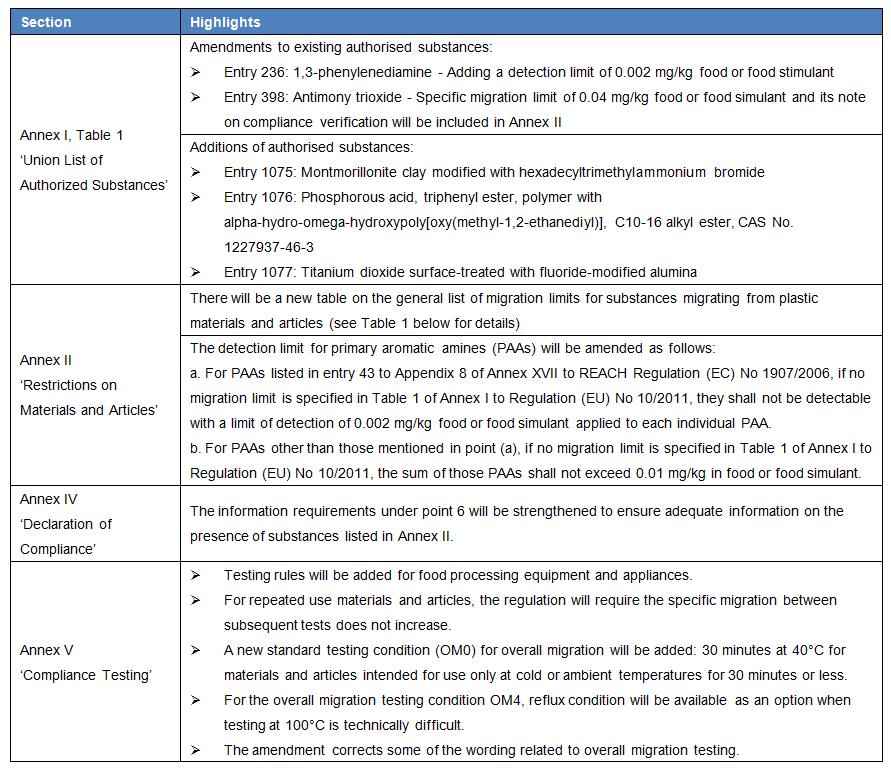
Table 1 General list of migration limits for substances migrating from plastic materials and articles:
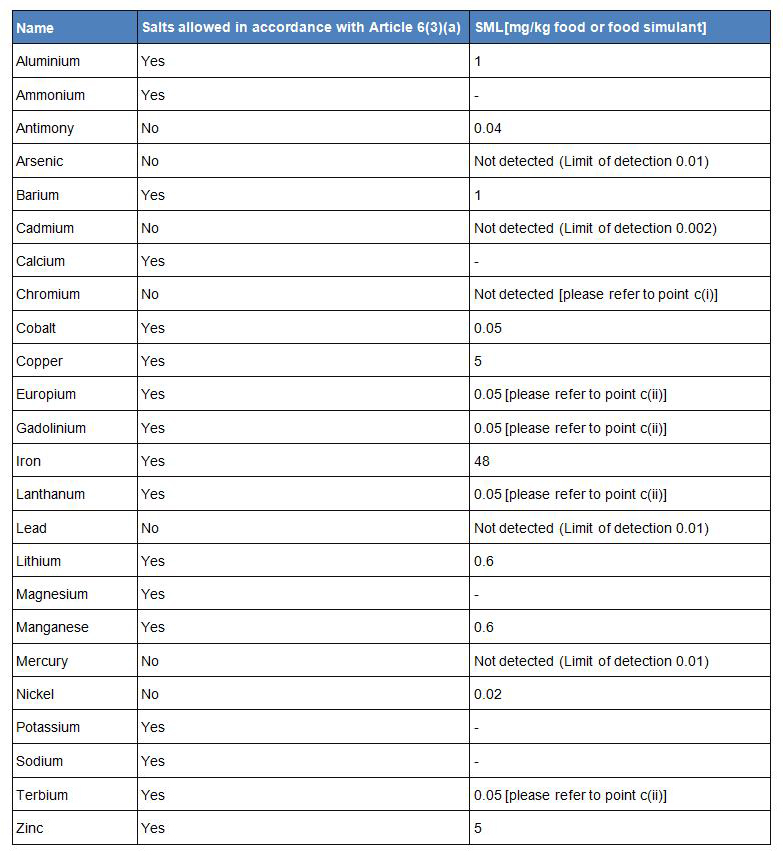
Here are some key points related to the above table:
a. The existing migration limits remain unchanged.
b. Article 6(3)(a) regarding the derogation of certain salts of authorised acids, phenols and alcohols will be incorporated into the second column of the above table.
c. There are additional remarks for some limits. The significant ones are:
i. For total chromium, the detection limit of 0.01 mg/kg shall apply. However, if the operator who place the food contact material on the market can prove that the presence of chromium (VI) is excluded, a limit of 3.6 mg/kg shall apply.
ii. For lanthanide substances (europium, gadolinium, lanthanum and terbium):
• The sum of all lanthanide substances migrating to food or food simulant shall not exceed the specific migration limit of 0.05 mg/kg
• There shall be analytical evidence using a well described methodology demonstrating the lanthanide substance(s) used are present in dissociated ionic form in the food or food simulant. The evidence shall form part of the supporting documentation referred to in Article 16.
BACL Service:
BACL, with its headquarter in Silicon Valley, it is a global and comprehensive international third-party testing and certification body. Currently we have physical and chemical testing labs in the United States, Shenzhen, Dongguan, Xiamen and other places, and we have accredited the certifications by UKAS (Lab No.: 7827), CNAS (Registration No.: L2408, L5662, L6290, L9963, L11432, IB0343), CPSC (Lab ID: 1112, 1415, 1647), CMA (No.: 2016192126Z, 2015192413Z) and other authorities.We offer a full range of testing services which cover footwear, toys, textile, clothing, leather, jewelry, groceries, food contact materials, cosmetics and electrical and electronic products, etc. We can help enterprises to complete the precise control of whole industry chain from raw materials to the finished products.