 CN/中国
CN/中国  US/USA
  KR/Korea
  DE/Germany
  ES/Spain
 VN/Việtnam
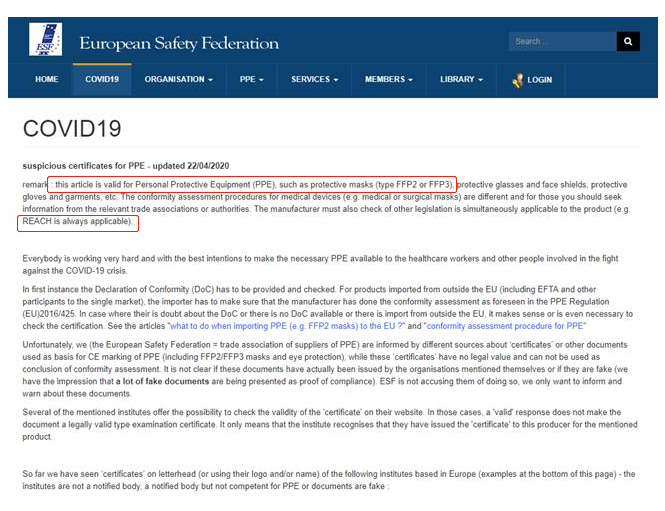
Recently, European Safety Federation has published an article on its official website regarding "counterfeiting" CE certificate of some current personal protective equipment (PPE). The article made it clear that protective masks (type FFP2 or FFP3), protective glasses and face shields, protective gloves and garments, etc., should meet the requirements of REACH Regulation besides the CE certification.
URL:
https://www.eu-esf.org/covid-19/4513-covid-19-suspicious-certificates-for-ppe
What is REACH Regulation?
Registration, Evaluation, Authorisation and Restriction of Chemicals (REACH) is a European Union regulation dating from 18 December 2006. REACH addresses the production and use of chemical substances, and their potential impacts on both human health and the environment. REACH entered into force on 1 Jun. 2007, and applied on 1 Jun. 2008. It becomes a harmonised regulation concerning preventative administration on all chemicals to be placed on the EU market superseding more than 40 directives and regulations for chemical management. REACH is also applicable to protective masks (type FFP2 or FFP3), protective glasses and face shields, protective gloves and garments, etc.
How can Personal Protective Equipment Such as Masks Meet REACH Regulations?
• Substance: Chemical elements and their compounds in the natural state (existing) or obtained through production processes.
• Preparation: A mixture or solution consisting of two ormore substances.
• Article: An article consisting of one or more substances and/or one or more preparations. Articles have specific shapes, appearances or designs.
* Personal Protective Equipment (PPE) is defined as Article
List of Toxic and Harmful Substances under REACH
Candidate List*——SVHC
SVHC, “Substance of Very High Concern”, refers to any substance that has adverse effects on human health and the environment. Strictly speaking, the list of SVHCs serves as a candidate list for List of Substances Subject to Authorisation.
According to Article 57 of the REACH Regulation, substances that have one or more of the following hazardous characteristics that causing high concern will be included to the SVHCs list:
• Substances which are Class1, Class2 carcinogenic, teratogenic, reproductively toxic, namely CMR1/2 substances;
• Substances which are Persistent, bioaccumulative and toxic, namely PBT substances;
• Substances which are highly persistent and highly bioaccumulative, namely vPvB substances;
• Substances such as those having endocrine disrupting properties or those having persistent, bioaccumulative and toxic properties or very persistent and very bioaccumulative properties, which do not fulfill the criteria of points 2 or 3-for which there is scientific evidence of probable serious effects to human health or the environment.
With the progress of the implementation of REACH, ECHA (European Chemicals Agency) has successively published a multi-batch SVHC list. As of January 16, 2020, the SVHC list has been updated to the 22nd batch, with a total of 205 substances.
Any producer or importer of articles shall submit a registration to ECHA for any substance contained in those articles, if both the following conditions are met: (a) the substance is present in those articles in quantities totalling over 1 tonne per producer or importer per year; (b) the substance is intended to be released under normal or reasonably foreseeable conditions of use.
Restricted substances RSL
Restricted substances are in the Annex XVII (also known as Restrictions on the Manufacture, Placing on the Market and Use of Certain Dangerous Substances, Preparations and Articles) to REACH. Any substance on their own, in a preparation or in an article should be restricted on
BACL reminded:
BACL reminded: in addition to CE certification and reach regulations, the export of Personal Protective Equipment (PPE) to the EU also needs to comply with pops regulations.
Restricted substances: PFOS, PCP, SCCP, etc.
BACL Solution:
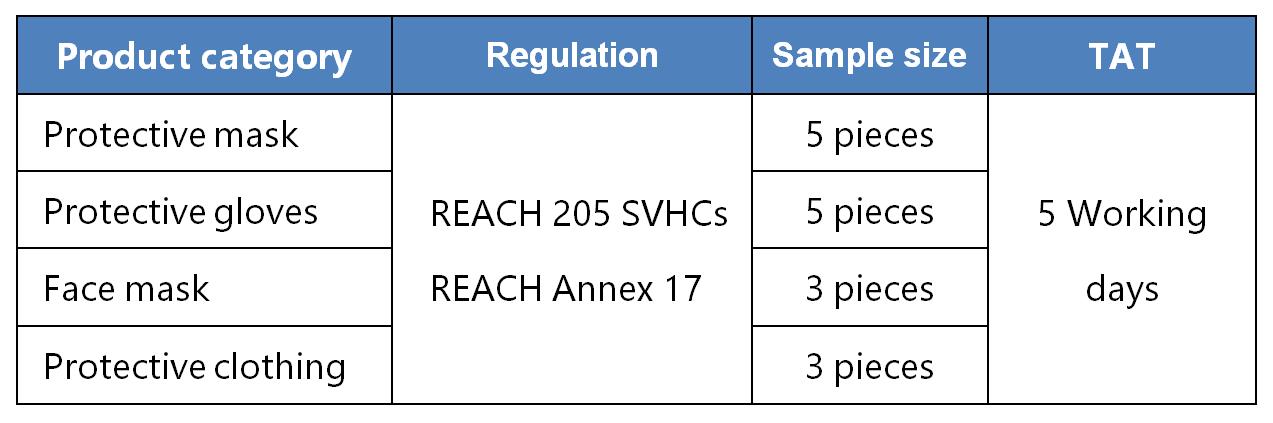
BACL Service:
BACL, with its headquarter in Silicon Valley, it is a global and comprehensive international third-party testing and certification body. Currently we have physical and chemical testing labs in the United States, Shenzhen, Dongguan, Xiamen and other places, and we have accredited the certifications by UKAS (Lab No.: 7827), CNAS (Registration No.: L2408, L5662, L6290, L9963, L11432, IB0343), CPSC (Lab ID: 1112, 1415, 1647), CMA (No.: 2016192126Z, 2015192413Z) and other authorities.We offer a full range of testing services which cover footwear, toys, textile, clothing, leather, jewelry, groceries, food contact materials, cosmetics and electrical and electronic products, etc. We can help enterprises to complete the precise control of whole industry chain from raw materials to the finished products.