
 CN/中国
CN/中国  US/USA
  KR/Korea
  DE/Germany
  ES/Spain
 VN/Việtnam
1. General information
Electrical and electronic products marketed in the EAEU must undergo conformity assurance procedures from 1 March 2020 to prove their compliance with EAEU Technical Regulation 037/2016 on the Restriction of the Use of Hazardous Substances in electrical and electronic equipment.
TR EAEU 037 establishes requirements to limit the use of hazardous substances in Products (hereinafter “Products”) released into circulation in the territory of the Eurasian Economic Union (Russia, Belarus, Kazakhstan, Armenia and Kyrgyzstan), to ensure their free circulation.
If other technical regulations of the Customs Union are adopted for Products that establish the requirements for these products, then such products must meet the requirements of all technical regulations of the Customs Union, the effect of which applies to them.
2. Products subject to the regulation (“Appendix 1”)
• The regulation applies to Products released into circulation on the territory of the Union:Electrical apparatuses and household appliances:
• For the preparation and storage of food and the mechanization of kitchen works, as well as other kitchen equipment;
• For processing (washing, ironing, drying, cleaning) of linen, clothes and shoes;
• For cleaning and tidying rooms;
• To maintain and regulate the indoor climate;
• Ssanitary and hygienic;
• For hair, nails and skin care;
• For heating the body;
• For vibration massage;
• Gaming, sports and training equipment;
• Audio and video equipment, television and radio broadcasting receivers;
• Sewing and knitting devices;
• Power supplies, chargers, voltage stabilizers;
• For gardening;
• Or aquariums and garden ponds;
• Electric pumps;
• Electric and electronic watches;
• Calculators;
• Wiring accessories;
• Extension cords.
Electronic computers and the peripherals (connected to them):
• Servers, system units of personal computers;
• Laptops;
• Tablets, handheld, palmtop and other small-sized computers;
• Keyboards, manipulators, trackers and other control and input devices (computer mice, joysticks, helmets, glasses);
• Rremovable storage devices;
• Monitors;
• Printers;
• Scanners;
• Speakers and headphones;
• Multimedia projectors;
• Readers of biometric information;
• Webcams;
• Modems;
• Uninterruptible Power System.
Telecommunication appliances (terminal telecommunication devices):
• Landline and mobile phones;
• Pay phones;
• Fax machines;
• Telexes;
• Portable and portable radio stations;
• RFID tags.
Copy machines and other electrical office equipment:
• Electrified Instrument (manual and portable electric machines);
• Light sources and lighting equipment, including equipment built into furniture;
• Electric musical instruments;
• Game and vending machines;
• Cash registers, ticket machines, ID card readers, ATMs, information kiosks;
• Cables, wires and cords intended for use at a rated voltage of not more than 500 V AC and/or DC, except for fiber optic cables;
• Automatic switches and residual current circuit breakers;
• Fire, security and fire-security alarm detectors.
3. Products not subject to the regulation
The regulation does not apply to the following products:
• Products intended for use at a rated voltage of more than 1000 V AC and 1500 V DC, unless otherwise provided in Appendix 1;
• Products intended exclusively for use as components of electrical and electronic equipment that are not listed in Appendix 1;
• Electric toys;
• Photovoltaic panels (solar panels), which are part of the Products;
• Products intended for use as part of ground and orbital space objects;
• Electrical equipment intended exclusively for use in air, water, land and underground transport;
• Electric batteries and accumulators, including those put into circulation on the territory of the • Union as a part of Products;
• Second-hand (operation) Products;
• Measuring instruments;
• Medical devices.
4. Forms of conformity assessment
Electrical and electronic equipment may only be put into circulation on the market of Russia and the EAEU if these are in compliance with the requirements of this and other Technical Regulations of the EAEU (e.g. TR CU 004/2011 On safety of low voltage systems and TR CU 020/2011 On electromagnetic compatibility) and the conformity of the products has been confirmed with the EAC marking.
The conformity assessment with the requirements of the Technical Regulation TR EAEU 037/2016 On restriction of the use of certain hazardous substances in electrical and electronic equipment is carried out in the form of an EAC Declaration and may be replaced upon request with an EAC Certificate.
The certification of electrical and electronic products is carried out exclusively by notified bodies, which are registered as such in the uniform register of the notified bodies and test laboratories of the EAEU.
5. Required procedures
The Product should be designed and manufactured in such a way that it does not contain:a) Hazardous substances as per Annex 2.b) Homogeneous materials containing hazardous substances in a concentration exceeding the maximum allowable level as specified in Annex 2 to this Technical Regulation.
Appendix 2
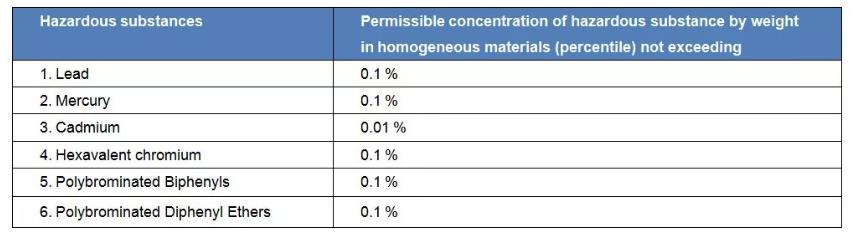
In relation to Products, special requirements are established to limit the use of hazardous substances in accordance with Appendix N 3 to the Regulation.
Further information please contact: bacllola@baclcorp.com.
6. Operational documents and marking
Product label requirements:
The name and/or designation of the Product (type, brand, model (if any), its main parameters and characteristics, the name and/or trademark of the manufacturer, the name of the state in which the manufactured Product, must be marked on the product and indicated in the operating documents attached to it.
The name and/or designation of the Product (type, brand, model (if any), and the name and/or trademark of the manufacturer must also be applied to the packaging.
If the above information cannot be applied to the Product, then it can be indicated only in the operating documents attached to the product. In this case, the name and/or designation of the Product (type, brand, model (if any), the name and/or trademark of the manufacturer must be applied to the packaging.
The marking of an electrical and electronic product must be legible, easy to read, and must be applied to the electrical and electronic product in a place accessible for inspection without disassembly using a tool.
Operational manual requirement:
Operational documents for a Product should contain:
• The name and/or designation of the Product (type, market name, model(if any), and the name and/or trademark of the manufacturer;
• The information specified above;
• Information about the purpose of the product;
• Characteristics and parameters of the product;
• Rules and conditions of operation (use), installation, storage, transportation, sale and disposal of the product (relevant requirements, if necessary);
• Information on measures to be taken when a product malfunction is detected;
• The name and location of the manufacturer (person authorized by the manufacturer), the importer, their contact information;
• Information about the month and year of manufacture of the product and/or the place of application of such information or the method for determining the year of manufacture.
Packing mark requirement:
The name and/ordesignation of the Product (type, market name, model (if any), and the name and/ortrademark of the manufacturer must also be applied to the packaging.
The marking and operational documents are carried out in Russian language, as well as inthe state language (official languages) of the Member State in whose territorythe products are sold, if such requirement is present in the legislation of thiscountry. Units of measure, alphabetic trademarks, proper names, names of placesand other names and details in the marking and operating documents may be givenin other languages.
Operational documents are made out on paper. A set of operational documents on electronicmedia may be attached to them. Operational documents included in the set of productsof electrical and radio electronics for non-domestic purposes, can be issuedonly on electronic media.
7. Marking with EAC mark
A Product that meets the requirements of this technical regulation and has passed the conformity confirmation procedure in accordance with Section VII of this technical regulation must be marked with an EAC mark. Marking with the EAC mark is carried out before the release of a product into circulation on the Union market. The EAC mark is applied to each Product in any way that provides a clear and clear image through out the life of the product, and is also given in the operating documents attached to it.
If it is impossible to apply the EAC mark on the Product, it is allowed to apply it only on the product’s packaging and in the operating documents attached to it. A Product is marked with the EAC mark when it meets the requirements of all technicalregulations of the Union (Customs Union), the effect of which applies to it.
BACL Service:
BACL, with its headquarter in Silicon Valley, it is a global and comprehensive international third-party testing and certification body. Currently we have physical and chemical testing labs in the United States, Shenzhen, Dongguan, Xiamen and other places, and we have accredited the certifications by UKAS (Lab No.: 7827),CNAS (Registration No.: L2408, L5662, L6290, L9963, L11432, IB0343),CPSC (Lab ID: 1112, 1415, 1647), CMA (No.: 2016192126Z, 2015192413Z) and other authorities.We offer a full range of testing services which cover footwear, toys, textile, clothing, leather, jewelry, groceries, food contact materials, cosmetics and electrical and electronic products, etc. We can help enterprises to complete the precise control of whole industry chain from raw materials to the finished products.