
 CN/中国
CN/中国  US/USA
  KR/Korea
  DE/Germany
  ES/Spain
 VN/Việtnam
The operating voltage of the product is a very important safety test item, and is also the necessary judging criteria for creepage distance and electric clearance. The inaccurate operating voltage measurement will directly lead to the wrong judgment of the electric clearance and creepage distance, which will directly cause the risk of product’s electric shock, leaving safety hazards to the users. Therefore, the product operating voltage measurement is particularly important.
Standard: GB 4943.1 "Information Technology Equipment Security Part 1: Basic Information of General Requirements"
GB 4943.1 for the measurement requirements of the operating voltage please refers to Section 2.10.2.1 of the Standard:
Basic Requirements:
All of following requirements are applicable when determining the operating voltage, (see 1.4.8):
a) Ungrounded accessible conductive parts shall be assumed to be grounded.
b) If the transformer winding or other component is floating (It is not connected to a circuit with a defined potential relative to ground), it should be assumed that the transformer winding or component is partially grounded and that the highest working voltage is generated due to this part of grounding.
c) For insulation between the two windings of the transformer, the maximum voltage between any two points on the two windings shall be taken after taking into account the external voltage to which the winding may be connected, except as permitted by 2.10.1.5.
d) If double insulation is used, the operating voltage on the basic insulation shall be determined in a state where the additional insulation is assumed to be short-circuited, and vice versa.
e) For double insulation between transformer windings, it should be assumed that a short circuit occurs at this point, due to this short circuit and the highest operating voltage on the other insulation.
f) When determining the operating voltage by measurement, the supply voltage of the EUT shall be the voltage that produces the highest measured value within the rated voltage or rated voltage range.
Note: The tolerance of the rated voltage or rated voltage range is not considered.
g) The operating voltage between any point in the primary circuit and ground and between any point in the primary circuit and the secondary circuit shall be assumed to be the greater of the following:
-----The upper voltage and the measured voltage of the rated voltage or rated voltage range.
The Selection and the Use of the Oscilloscope:
Oscilloscope, as the primary measuring device when testing the operating voltage, its proper operation is especially important. The type of oscilloscope, the settings of the oscilloscope, what measurement range to choose, the amplification factor of the oscilloscope probe and so forth are all need attention. The specific requirements are as follows:
1)Measurement range selection of oscilloscope: When the oscilloscope measures the same operating voltage, different measurement range will cause different reading values.
2)Oscilloscope probe’ amplification factor: When using HVD probe, there will be a certain attenuation ratio, that requires a matched probe amplification factor the before using the oscilloscope, otherwise, it will cause incorrect indicating value.
3)Oscilloscope setting: The Coupling mode shall be "DC coupling", and the oscilloscope bandwidth shall be "1MΩ"
4)Safety Precautions: When testing with oscilloscope, please note that the isolation transformer shall be connected to the front end of the oscilloscope.
Influence of Oscilloscope Probe on Test:
1)The impact of the oscilloscope:
An oscilloscope probe is a bridge between the signal being measured and the oscilloscope. The distortion of the signal happened at the probe will directly result in the unobtainable of true waveforms and data. Only using a proper measuring probe can ensure the accuracy of the measured data.
2)The selection of oscilloscope probe:
For the measurement of the operating voltage between the primary end and secondary end of the transformer in the switching power supply, it is possible to get high voltages of up to several hundred volts or even thousands of volts. Generally, the selected oscilloscope probe should be with a value greater than or equal to 100:1, after being attenuated, the oscilloscope will display the amplified data. Although the use of a high voltage probe can enlarge the attenuation factor to increase the measurement voltage range, the oscilloscope's own noise may be increased when the oscilloscope amplifies, thereby affecting the accuracy of the test data. Thus, choosing a probe with proper attenuation factor is also important. The input impedance of the probe can be equivalent to the parallel connection of the resistor and the capacitor. Since the frequency of the transformer is not very high, the load of the probe at low frequencies (below 1 MHz) is mainly a resistance.
In order to reduce the load of the probe on the circuit under test, a high-impedance, low-capacitance probe should be selected.
Primary and Secondary Common Potential:
There must be a common reference between the primary end and secondary end of the circuit. This reference must be set in the device under test. Regardless of whether the device under test is a Class I or Class II device, the primary and secondary common reference should be re-set in the device regardless of whether the primary "ground" and secondary "ground" within the device are connected.
During the test of the working voltage, the various working modes and states of the product must be considered in place. The most stringent working mode and state should be selected to obtain the maximum working voltage and measure it.
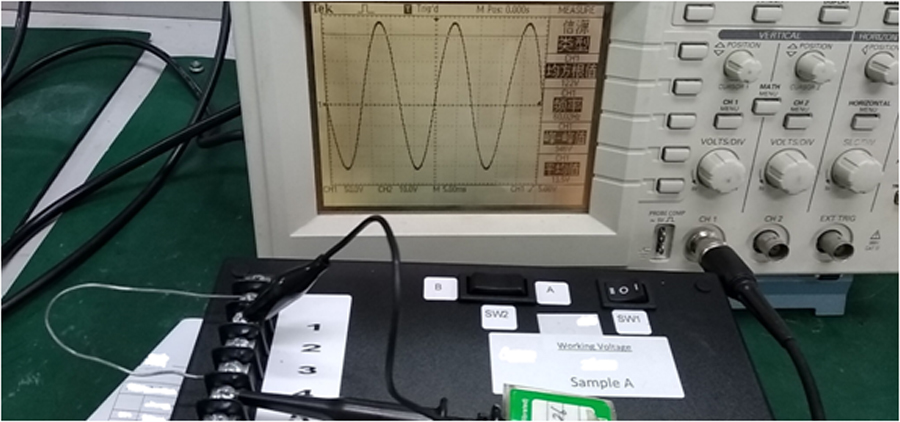
The Impact of Load:
During the test of the operating voltage, the various working modes and states of the product must be considered adequately. The most stringent working mode and state should be selected to obtain the maximum operating voltage and measure it.
BACL Service:
BACL is a North American Safety Certification Body accredited by OSHA and SCC of Canada (Authorization criteria: UL 60950-1, UL 62368-1, UL 1993, UL1310, UL 1598C, UL1598, UL8750, UL 153) , at the same time, it also obtained authorization and approval from A2LA, IAS, IECEE, CNAS, CMA, FDA, ACMA, SAA, etc. There are safety testing laboratories in the United States, Taiwan, Shenzhen, Dongguan, Chengdu, Kunshan and other places. We can provide you with IT / AV, HOUS, Lighting products, Power products, North American NRTL for various types of electronic appliances such as power tools, EU CE, International Electro technical Commission IECEE CB Scheme, Australian SAA, Japanese PSE, Korea KC, Nigeria SONCAP, Saudi SASO and other testing and certification services.