
 CN/中国
CN/中国  US/USA
  KR/Korea
  DE/Germany
  ES/Spain
 VN/Việtnam
From April 30 to May 2, 2019, IEC 62368 - X Standard Council (TC108 HBSDT) held technology conference in North Carolina in the United States, mainly discussed the 3rd edition of IEC 62368-1 proposal and related questions, and reached a consensus on a part of the problems. Subsequently, it will be released as a resolution or directly added in the new standard. The issue which is discussed most heatedly in the meeting is about the battery, which is as follow:
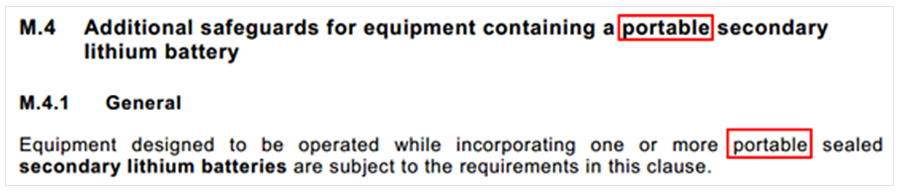
Issue 1: Portable in the appendix M. 4 refers to battery or end product?
Appendix M.4 of IEC 62368-1 sets forth new requirements for rechargeable lithium batteries that are found in neither IEC60950-1 nor IEC60065, particularly the M. 4.2 charging protection requirements under high and low temperature. However, the scope of application of M. 4 is always disputed:
Viewpoint A: M.4 applies only to end product of “portable”. It is because portable is not defined in IEC 62368-1 but is defined in IEC 62133. According to its definition, portable refers to the end product, not the battery itself. It is also defined in 108/581/INF of IEC TC.
Viewpoint B: According to the background explanation of M.4 in IEC 62368-2, the original intention of M.4 is to put forward the requirements for the end product fall under 62368 which is aimed at the rechargeable lithium battery, a high-risk battery. The portable originally refers to the lithium battery fall under IEC 62133, therefore, M. 4 applies to all end products with such lithium batteries.
TC108 HBSDT May 2019 meeting to discuss decision:
The viewpoint B is true that portable in M. 4 will be eliminated in the latest version of IEC 62368-1 as is shown below. This decision also applies to IEC 62368-1 V2.
Issue 2: conditions for exemption of fire enclosures for multi-cell batteries
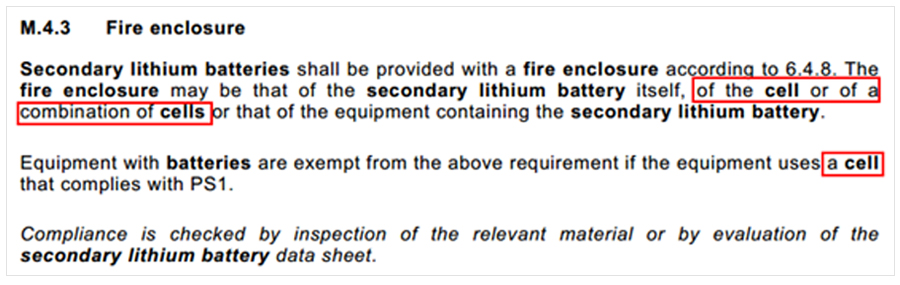
IEC 62368-1, V3, M. 4.3 specifies the condition for the exemption of the battery fire enclosure, that is, when the energy output of the cell <=PS1, the battery pack of this cell does not need the fire enclosure. However, according to the text description of current standard, for multi-cell battery pack, can the battery be exempt from a fire enclosure when a single cell meets PS1? or only when the output of a combination of cells meet PS1 can the battery be exempted from fire enclosure?
As shown in the figure below, "a cell" and "a combination of cells" are mentioned in standard M. 4.3, but the meaning is unclear.
TC108 HBSDT decision made on meeting on May 2019:
"a cell or of a combination of cells" in the first paragraph of M.4.3 is misplaced, and shall be put in the second paragraph as "a cell or of a combination of cells".
The original intention of TC108 is that in the case of a combination of cells, the total output of the cells is required to comply with PS1, that the battery can be exempted from the fire enclosure. A correction to this description will be added to the next revision of IEC 62368-1.
Issue 3: shall the fire enclosure of lithium battery pack be upgraded to V-0?
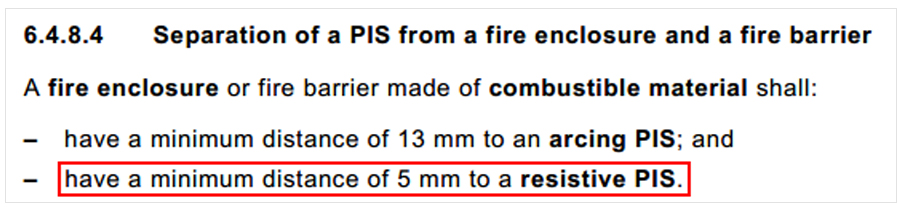
In accordance with section 6.4.8.4 of IEC 62368-1 V2 or V3, if the distance between the fire enclosure and the internal resistance PIS is less than 5mm, the flame retardant grade of the enclosure shall be raised to V-0. For the lithium battery pack, there are following problems:
1) Shall the internal cell be regarded as resistive PIS?
2) Shall the resistive PIS of the internal charge and discharge control circuit be assessed?
3) As for the fire enclosure of lithium battery pack, the manufacturer has always designed it with V-1 according to the requirements of the industry (such as UL2054). Is it necessary to upgrade the requirement to V-0?
TC108 HBSDT decision made on meeting on May 2019:
If the shell of lithium battery pack is treated as fire enclosure, V-1 can be accepted, and the requirements of 6.4.8.4 do not need to be considered. This decision will be issued as a relevant resolution in the future.
BACL Service:
BACL battery laboratory focuses on the study of the battery standards over the world, and is always keeping an eye on the industry trends and the update of standards, and maintaining a good cooperation with well-known institutions at home and abroad. Our lab is equipped with first-class testing equipment and instruments of the industry according to the latest national and international standards (IEC 62133, EN 62133, UL1642, UL 2054, UL 2056, GB 31241) to meet various needs of our customers for battery testing, save valuable certification time to the utmost for customers, and help their products access to the global market more easily and more conveniently.