
 CN/中国
CN/中国  US/USA
  KR/Korea
  DE/Germany
  ES/Spain
 VN/Việtnam
With the development of science and technology, energy efficiency gets more and more attention around the world, and the related requirements are getting more rigorous. On December 28, 2018, the United States released the Energystar imaging equipment products specification V3.0 final edition. The key information is as follows:
Effective Timetable:
1 ) V3.0 will take effect on October 11, 2019 (6.1.1).
2 ) The application for V 2.0 will be ceased on May 15, 2019. The existing V2.0 will remain valid till October 11, 2019.
Change One:
1 ) Removing the Copier and Fax Machine from the product list:
Deleting the original restriction of two or more core functions (Clause A item 5 and 2.2.2).
The following products cannot do Energystar certification:
i. Products that are designed to operate directly on three-phase power;
ii. Standalone Copiers; and
iii. Standalone Fax Machines.
2 ) Adding Professional Imaging Product into the product list
Listing the requirements (Clause A item 8) for products related to Professional Imaging Product.
Change Two:
The concept of Recover time and the test thereof are added. The time recovering from Sleep mode or Off-mode to Ready state shall be measured (Clause 4 and 3.3.4).
Change Three:
Adding requirements for professional digital front end (DFE) product (1.0 Clause E item 5d).
Change Four
Improving EPS external power adapter energy efficiency level from V to VI. (3.2.1)
The test method meets DOE's Appendix Z to 10 CFR Part 430.
i. Single- and Multiple-voltage EPSs shall include the Level VI or higher marking.
ii. Additional information on the Marking Protocol is available at http://www.regulations.gov/#!documentDetail;D=EERE-2008-BT-STD-0005-0218.
iii. The above requirements shall not apply to any EPSs shipped with a Digital Front End (DFE)
Change Five:
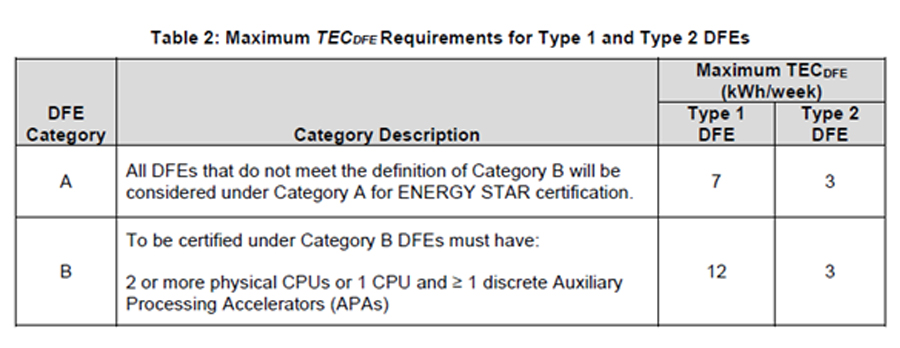
Reducing requirements for TECDFE weekly power limit (3.2.4 Table 2).
Change Six:
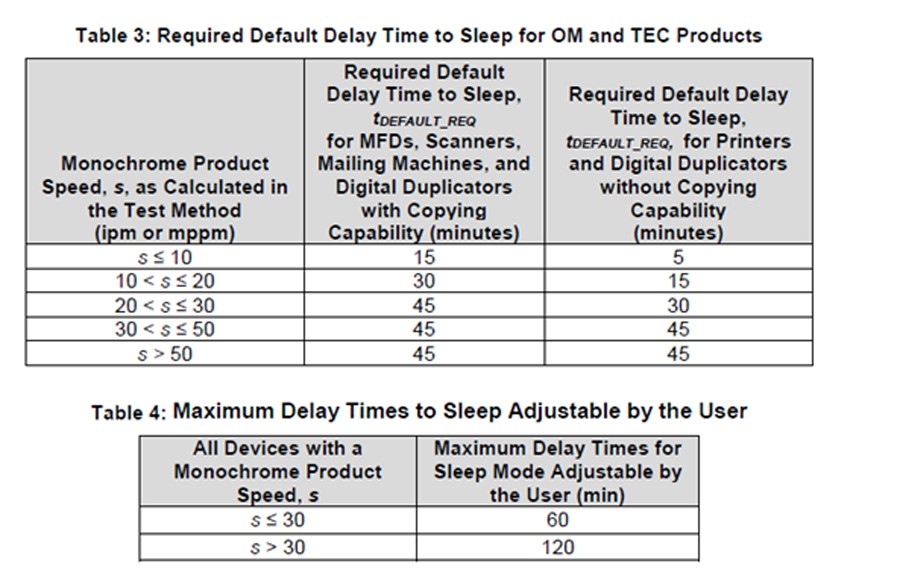
Adding default delay requirements for non-professional imaging products (3.2.5), see Table 3 and 4 for details.
Change Seven:
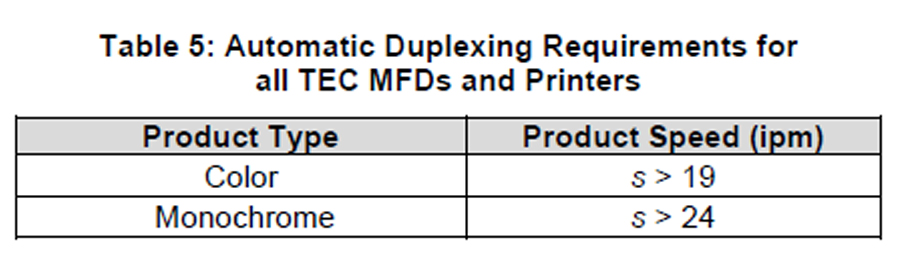
Redefining working mode and energy efficiency test requirements for Automatic Duplexing (3.3.1), see Table 5 for details.
Change Eight:
Modifying the A3 limit in the Maximum TEC Requirement Calculation from the original 0.3kwh/week to 0.05kwh/week and adding the energy consumption limit- 0.1kwh/week of using Wi-Fi function in the formula. (3.3.2 Equation 6)
Change Nine:
Modifying the Power limit of Multifunction Device-MFD under Sleep Mode Power Allowance in Table 10,deleting the energy consumption requirements for Scanner and Internal Disk Drives under sleep mode in Table 11. (3.5.3).
Change Ten:
Modifying the limit and the definition of standby power consumption, evaluating with 3.5.4 Off-Mode Consumption, changing the limit value from 0.5w to 0.3w.(3.5.4 Table12).
Change Eleven:
Originally, there is only one test method and is available for all products
Now, there are two methods, one for professional Imaging products and the other for all other non-professional Imaging Products (4.1).
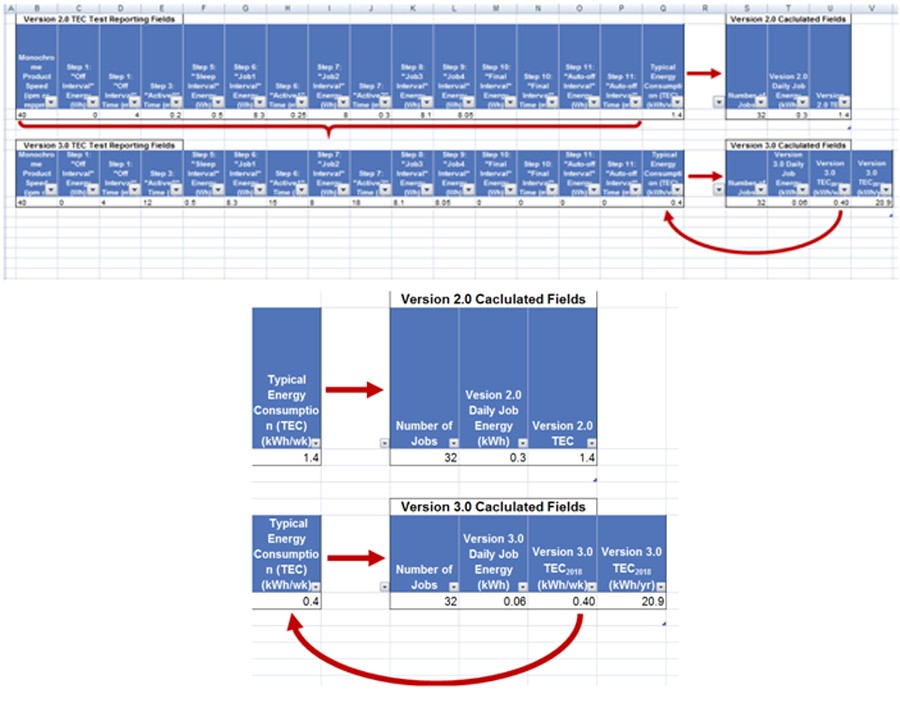
Change Twelve : Update Version3.0 TEC Calculator
BACL Service:
As a NRTL body accredited by OSHA in U.S.A and a SCC-accredited body in Canada, BACL can provide you with North America safety testing and certification services. BACL is also the FCC TCB certificate issuing body, the United States EPA Energystar CB certificate issuing body, the highest-level notice body of CE NB in the EU and one of the ISED FCB certificate issuing bodies in Canada that it can provide you with energy efficiency testing and certification services for electronic products such as battery chargers BCS’s DOE in the United States, California CEC, Canada NRCan, the EU CE ERP, Australia MEPS to help your products enter into the international market smoothly ! Welcome to contact us!