
 CN/中国
CN/中国  US/USA
  KR/Korea
  DE/Germany
  ES/Spain
 VN/Việtnam
The EU Packaging and Packaging Waste Regulation (EU) 2025/40 (PPWR) will be fully implemented on August 12, 2026. The regulation covers all packaging and packaging waste, imposing control requirements throughout the entire packaging lifecycle, including mandatory provisions on sustainability performance, labelling, extended producer responsibility (EPR), and packaging waste reduction/prevention. Relevant companies are advised to prepare for compliance in advance.
Scope of Application
■ Applicable subjects: All types and materials of packaging, packaging materials, and packaging waste, covering both B2B and B2C.
■ Geographical scope: The 27 EU Member States and Northern Ireland of the United Kingdom. Non-EU enterprises that place packaging on these markets are also subject to this regulation.
‘packaging’ means an item, irrespective of the materials from which it is made, that is intended to be used by an economic operator for the containment, protection, handling, delivery or presentation of products to another economic operator or to an end user, and that can be differentiated by packaging format based on its function, material and design. Examples include but are not limited to cartons, sealing tape, bubble wrap, stretch film, and pallets.
Types of Packaging
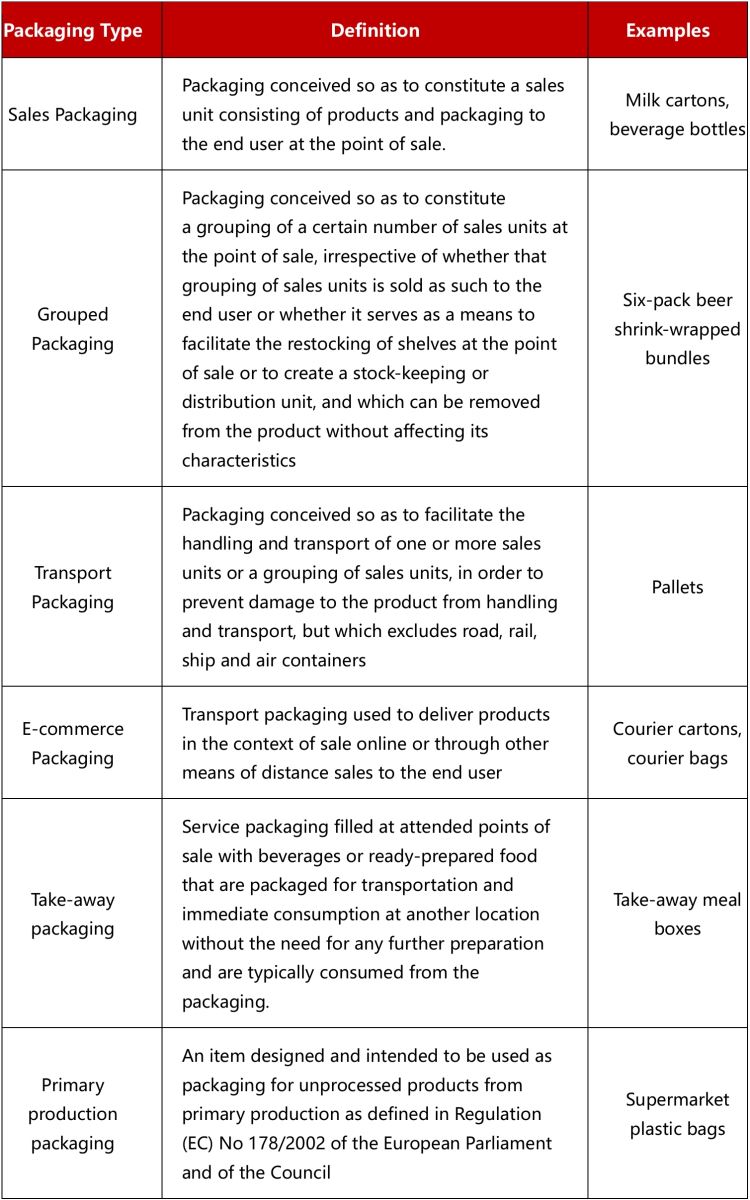
Requirements to be Met by August 12, 2026
1. Hazardous Substances (Art. 5)
• Four heavy metals: All packaging must have the sum of lead, cadmium, mercury, and hexavalent chromium ≤ 100 mg/kg.
• PFAS: For food contact packaging:
(1) Each PFAS (polymeric PFASs excluded): < 25 ppb.
(2) Sum of PFASs (polymeric PFASs excluded): < 250 ppb.
(3) Sum of PFASs (polymeric PFASs included): < 50 ppm. (Total fluorine (F): 50 mg/kg (50 ppm) (If total fluorine (F) exceeds 50 mg/kg, a proof for F quantity measured as content of either PFAS or non-PFAS shall be provided upon request))
• Substances of Concern (SoC): The concentration of Substances of Concern in packaging must be minimised. The European Commission, in cooperation with the European Chemicals Agency, will publish a SoC list, expected by December 31, 2026. It is likely to refer to the REACH SVHC list.
• PPWR also emphasises that packaging must comply with the restricted substances in REACH Annex XVII, and if it is food contact packaging, it must meet the requirements of the EU Food Contact Materials Regulation (EC) No 1935/2004.
2. Recyclability (Art. 6)
From August 12, 2026, all packaging placed on the EU market must be recyclable, and must meet specific recyclability grades in phases. Detailed design‑for‑recycling requirements and assessment methods have not yet been published; for now, a declaration of packaging recyclability is sufficient. Implementing standards are expected to be published by the European Commission by January 1, 2028.
.jpeg)
3. Documentation Compliance (Art. 38/39)
• Manufacturers must carry out a packaging conformity assessment, prepare technical documentation, and issue an EU Declaration of Conformity (EU DoC).
• Retention period for technical documentation and DoC: 5 years for single‑use packaging; 10 years for reusable packaging.
• Upon request by competent authorities, the full technical documentation and DoC must be provided within 10 working days.
4. Extended Producer Responsibility (EPR) Registration (Art. 44)
From August 12, 2026, producers placing packaged goods on the EU market must register, in each Member State where they first place such packaged goods, with the competent authority or a designated producer responsibility organisation, and obtain a unique EPR registration number for that Member State. EPR registration must be done separately in each target Member State; registration numbers are not mutually recognised across countries.
5. Labelling and Marking (Art. 15/16)
The manufacturer/importer's name, registered trade name or trademark, and contact address must be indicated on the packaging to allow traceability by competent authorities.
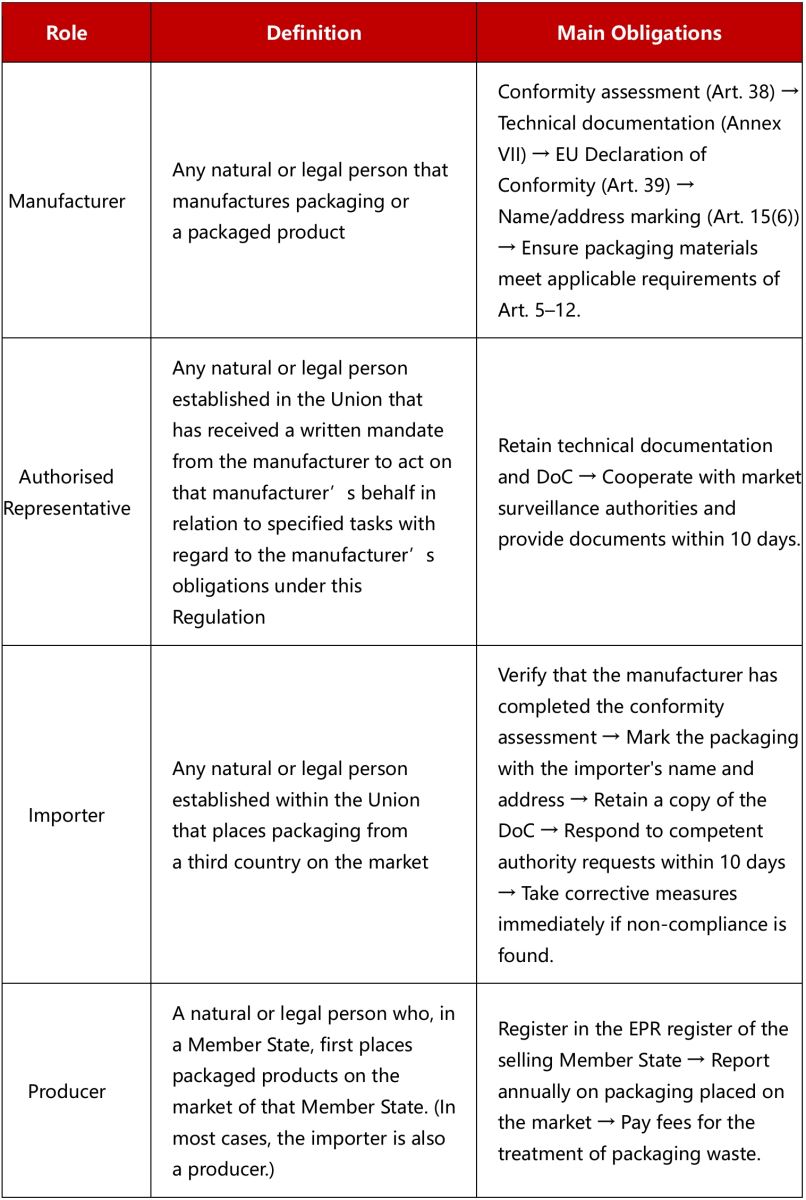
Roles and Obligations of Main Economic Operators
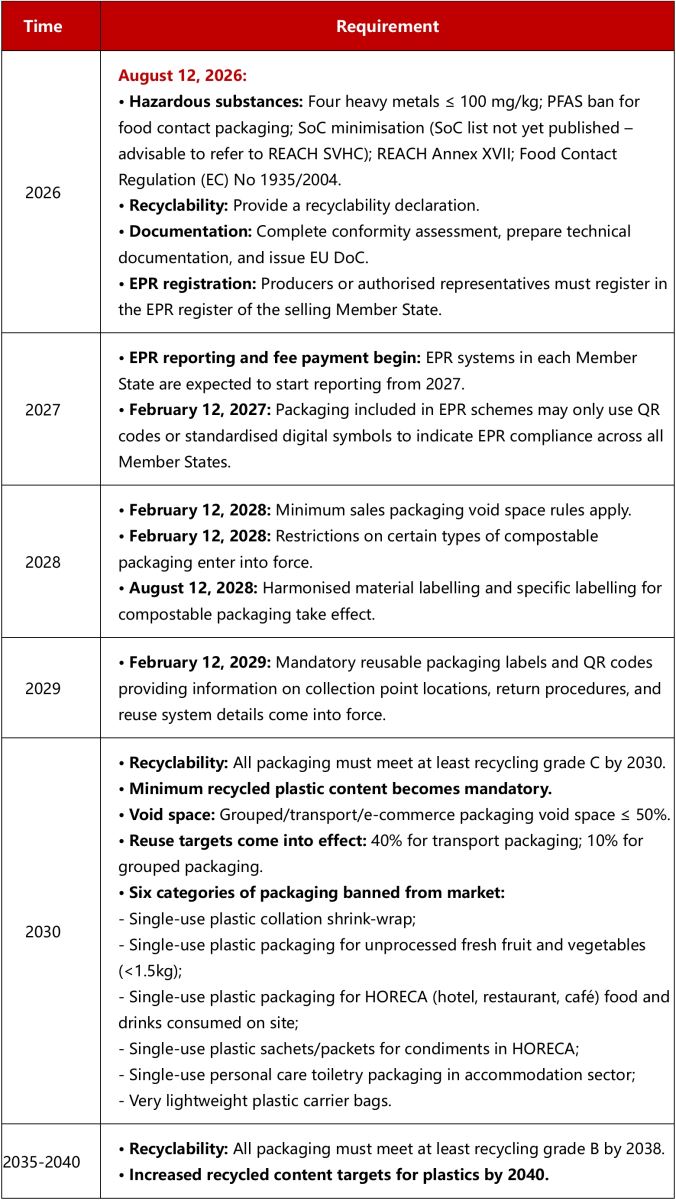
Compliance Timeline
What companies should do now?
• Map all packaging components
Create an inventory of every packaging component used for EU-bound products, including boxes, bags, trays, inserts, bottles, closures, labels, tape, films and transport packaging.
• Collect material information
Record the composition, weight, supplier, recycled content and intended function of every packaging component.
• Review chemical risks
Confirm compliance with the heavy-metal limit and assess PFAS or other relevant substances based on the material, surface treatment and intended use.
• Assess recyclability
Review characteristics that could affect recycling, including: Material combinations、Separability、Coatings、Adhesives、Inks、Closures、Labels、Component size、Compatibility with established recycling streams.
• Justify the packaging design
Document why every component, dimension and amount of empty space is necessary for product protection, safety, hygiene, transportation or another recognized function.
• Prepare compliance records
Establish a process for preparing and maintaining the technical documentation and packaging EU Declaration of Conformity.
• Audit EU market access
Identify every Member State where packaged products are first supplied and confirm the applicable EPR registration, reporting, fee and authorized-representative obligations.
• Monitor secondary legislation
Several methodologies, technical criteria and label formats depend on delegated or implementing acts that are still being developed. Compliance programs should be updated as these measures are adopted.
How BACL can support PPWR readiness?
BACL can build systematic PPWR compliance solutions for manufacturers, brand owners, and importers, combining packaging materials, intended use, supply chain layout, and target sales countries in the EU to customize exclusive compliance services, including:
• Regulatory gap assessment
Reviewing packaging portfolios against applicable PPWR obligations, documentation requirements and implementation dates.
• Testing coordination
Supporting chemical testing for heavy metals, PFAS and other relevant substances when testing is appropriate for the material and intended use.
• Material and supplier review
Assessing material specifications, supplier declarations, recycled-content evidence and other supporting records.
• Technical documentation support
Helping companies organize the evidence required for packaging conformity assessment and preparation of the EU Declaration of Conformity.
• EPR market mapping
Helping identify the EU Member States and sales routes that require further registration, reporting or authorized-representative review.
Early preparation allows businesses to identify packaging that may require redesign, obtain better evidence from suppliers and address registration gaps before enforcement affects access to the EU market.
BACL Services:
BACL can provide you efficient and reliable global market certification services, such as IECEE CB Scheme NCB and CBTL, United States(NRTL, FCC, ENERGY STAR), Canada(ISED, SCC), EU(CE), United Kingdom (UKCA AB & AOC), Northern Ireland(UKNI), Korea(KC), Japan(MIC), Singapore(IMDA),China Hong Kong(OFCA), China Taiwan (NCC, BSMI), Egypt (NTRA, GOEIC), South Africa(SABS), Vietnam (MIC), Saudi Arabia (SASO, CITC), Philippines (NTC), Thailand (NBTC), Malaysia (SIRIM), India(BIS, WPC, TEC)and other services to assure your products still smoothly entering into the international trade market even when the international trade barriers are becoming increasingly fierce.