
 CN/中国
CN/中国  US/USA
  KR/Korea
  DE/Germany
  ES/Spain
 VN/Việtnam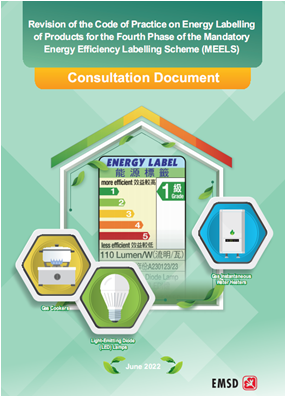
In June 2022, the Hong Kong Electrical and Mechanical Services Department issued a consultation document on the revision of the "Code of Practice for Energy Labeling of Products" for the fourth phase of the mandatory energy efficiency labeling scheme, The document states that the revised fifth edition of the "Code of Practice on Energy Labeling of Products" will come into effect in the second quarter of 2023, the fifth revision will add energy efficiency labeling requirements for light-emitting diode (LED) lamps.
The detailed technical requirements for Light Emitting Diode (LED) Lamps in this regulation are as follows:
15、Energy Efficiency Labelling for Lighting Emitting Diode Lamp.
15.1、Scope.
15.1.1、Clause 15 of the Code, unless the Director provides otherwise, applies to a lighting emitting diode (LED) lamp defined in the ordinance, that is, the products specified in clauses 15.1.2 and 15.1.3.
15.1.2、“Lighting emitting diode lamp”, subject to clause 15.1.3 of the Code, means a product –
(a) that is a type of directional or non-directional lighting emitting diode lamp which has a single lamp cap;
(b) that is of integrated type;
(c) that is intended for general lighting purposes, and –
(i) uses mains electricity as the only power source; and
(ii) has a rated lamp wattage up to 60 watts, whether or not having a dimming feature.
15.1.3、“Lighting emitting diode lamp” does not include –
(a) lighting emitting diode tubes;
(b) lighting emitting diode lamps that solely produce tinted or coloured light; or
(c) organic lighting emitting diode lamps.
15.3、Tests Required to be Carried Out.
The tests specified in this clause are required to be carried out, in accordance with IEC 62612 or other equivalent international standards approved by the Director, in order to find out the energy efficiency and performance characteristics of a light emitting diode lamp. A test report required to be submitted to the Director under section 6 of the ordinance shall contain the results of these tests:
(a) Measurement of luminous flux (initial);
(b) Measurement of power consumption (initial);
(c) Measurement of standby power consumption (initial);
(d) Measurement of colour rendering index (initial and at 6 000 hours)
(e) Measurement of colour consistency (initial and at 6 000 hours);
(f) Measurement of displacement factor (initial);
(g) Measurement of number of switching cycles;
(h) Measurement of lumen maintenance at 6 000 hours; and
(i) Measurement of lamp survival factor at 6 000 hours.
15.4.2、Family Grouping.
(d) For LED lamps of the same characteristics but with different colour temperatures, they shall be tested individually as their energy efficiency performances are different. For LED lamps with the same energy efficiency and performance characteristics (including colour temperature), but with different lamp caps, they may be treated as belonging to the same family of models and adopt the same test report.
15.5、Energy Efficiency Grading.
15.5.1、The energy efficiency grading of an LED lamp shall be determined as shown in Table 15.1, with Grade 1 having the best performance and Grade 5 having the worst performance.
15.5.2、In order to determine the energy efficiency grading according to clause 15.5.3 of the Code, the measured luminous efficacy (Em) obtained in clause 15.4 of the Code shall be compared with the following rated luminous efficacy (Er) which is determined and calculated based on the rated luminous flux and the rated wattage of the same product model –

The energy efficiency grading is determined by using the measured lamp luminous efficacy (Em) or the rated lamp luminous efficacy (Er), whichever is smaller.
Table 15.1 – Derivation of Energy Efficiency Grades.

Note: X = measured lamp luminous efficacy (Em) or the rated lamp luminous efficacy (Er), whichever is smaller.
15.5.3、The aforesaid measured luminous efficacy refers to the average values (both luminous flux and power consumption) measured after stabilisation of the LED lamp.
15.5.4、The aforesaid lumen maintenance refers to the average value measured after stabilisation of the LED lamp.
15.5.5、Unless otherwise indicated, the requirements set forth in the Code shall apply to non-dimmable LED lamps, and also to LED lamps with dimming control and/or adjustable colour that are operating at maximum power.
15.6、Performance Requirements.
15.6.1、In the test report submitted to the Director under clause 6 of the Code, the results of the test carried out in accordance with CIE 84, IEC 62612, IEC 62301 or other equivalent international standards approved by the Director shall show that the model concerned of the LED lamp conforms with the following performance requirements –
(a) The initial luminous flux of each individual LED lamp in the measured sample shall not be less than the rated luminous flux by more than 10%. The average of the measured initial luminous flux of all tested lamps shall not be less than the rated luminous flux by more than 7.5%.
(b) The initial power consumed by each individual LED lamp in the measured sample shall not exceed the rated power by more than 10%. The average of the measured initial power consumption of all tested lamps shall not exceed the rated power by more than 7.5%.
(c) The average of the measured initial standby power consumption shall be no more than 0.5W in standby mode.
(d) The colour rendering index of each individual LED lamp in the measured sample shall not be less than 80 in the initial measurement and at the end of 6 000 hours.
(e) The spread of chromaticity of each individual LED lamp in the measured sample shall fall within a 6-step MacAdam ellipse in the initial measurement and at the end of 6 000 hours.
(f) For rated power that is greater than 2W and less than or equal to 5W, the average displacement factor shall not be less than 0.4; for rated power that is greater than 5W and less than or equal to 25W, the average displacement factor shall not be less than 0.7; for rated power that is greater than 25W, the average displacement factor shall not be less than 0.9.
(g) For rated lamp life that is greater than or equal to 30 000 hours, the number of switching cycles of individual tested LED lamp shall be greater than or equal to 15 000 cycles; for rated lamp life that is less than 30 000 hours, the number of switching cycles of individual tested LED lamp shall be greater than or equal to half the rated lamp life in hours.
(h) The average measured lumen maintenance at the end of 6 000 hours shall not be less than 80%.
(i) The average measured lamp survival factor at the end of 6 000 hours shall not be less than 90%.
15.6.2、The rated power consumption, rated luminous flux, rated chromaticity co- ordinates, rated colour rendering index, rated displacement factor, rated lamp life as declared by the manufacturer or importer shall meet the requirements specified in clause 15.6.1 of the Code.
15.8、Number of Samples to be Tested.
15.8.1、For submission of product information of a model under section 6 of the ordinance, a test report on samples of the model shall be submitted. The minimum number of samples for the tests are indicated in Table 15.2.
Table 15.2 – Minimum Number of Samples for Tests.
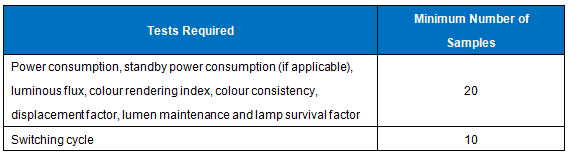
(Remark: The same samples shall be used for the above tests. LED lamps used in the switching cycle test shall not be used in other tests.)
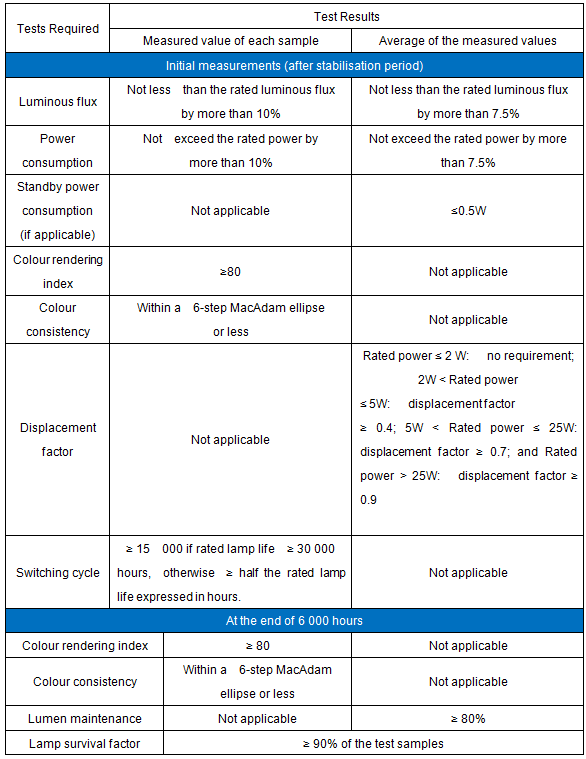
15.8.2、The test results of the samples shall be determined in accordance with the requirements in Table 15.3 and meet the performance requirements in clause 15.6 of the Code.
Table 15.3 – Determination of Test Results.
15.8.3、The measured luminous efficacy shall be determined by computing the ratio of the average
value of the luminous flux and the average value of the power consumption as determined in accordance with clause 15.4 of the Code. The resulting quotient shall be rounded off to the nearest unit of a lumen per watt.
15.10 Compliance.
15.10.1、During the compliance monitoring testing carried out by the Director, a listed model of LED lamp will be accepted as conformance if the test results of the listed model meet the following criteria: (Note: The minimum number of samples and the determination of test results are shown in Table 15.2 and 15.3 respectively.)
(a) The initial luminous flux of each individual LED lamp in the measured sample shall not be less than the rated luminous flux by more than 10%. The average of the measured initial luminous flux of all tested lamps shall not be less than the rated luminous flux by more than 7.5%.
(b) The initial power consumed by each individual LED lamp in the measured sample shall not exceed the rated power by more than 10%. The average of the measured initial power consumption of all tested lamps shall not exceed the rated power by more than 7.5%.
(c) The average of the measured initial standby power consumption shall be no more than 0.5W in standby mode.
(d) The colour rendering index of each individual LED lamp in the measured sample shall not be less 80 in the initial measurement and at the end of 6000 hours.
(e) The spread of chromaticity of each individual LED lamp in the measured sample shall fall within a 6-step MacAdam ellipse in the initial measurement and at the end of 6 000 hours.
(f) For rated power that is greater than 2W and less than or equal to 5W, the average displacement factor shall not be less than 0.4; for rated power that is greater than 5W and less than or equal to 25W, the average displacement factor shall not be less than 0.7; for rated power that is greater than 25W,the average displacement factor shall not be less than 0.9.
(g) For rated lamp life that is greater than or equal to 30 000 hours, the number of switching cycles of individual tested LED lamp shall be greater than or equal to 15 000 cycles; for rated lamp life that is less than 30 000 hours, the number of switching cycles of individual tested LED lamp shall be
greater than or equal to half the rated lamp life in hours.
(h) The average measured lumen maintenance at the end of 6 000 hours shall not be less than 80%.
(i) The measured lamp survival factor at the end of 6 000 hours shall not be less than 90%.
(j) The energy efficiency grade calculated in the compliance monitoring testing being equal to or better than the energy efficiency grade determined by the test results submitted to the Director by the specified person.
15.10.2、The Director may remove from the record the reference number of a listed model of LED lamp, if he has reasonable grounds to believe that the LED lamp does not conform with the specified information or a specified document or their updates submitted to the Director. The specified person may provide explanation on the failure of a product to pass the compliance monitoring testing stipulated in clause 15.10.1 above and apply for further testing of the concerned model for the Director’s consideration.
15.10.3、If further testing is approved to be carried out, the number of samples of the same model as indicated in Table 15.2 of the Code shall be tested at the specified person’s own costs and the determination of test results as indicated in Table 15.3 shall be followed. A listed model of LED lamp will be accepted as conformance if the results of further testing meet the following criteria:
(a) The initial luminous flux of each individual LED lamp in the measured sample shall not be less than the rated luminous flux by more than 10%. The average of the measured initial luminous flux of all tested lamps shall not be less than the rated luminous flux by more than 7.5%.
(b) The initial power consumed by each individual LED lamp in the measured sample shall not exceed the rated power by more than 10%. The averageof the measured initial power consumption of all tested lamps shall not exceed the rated power by more than 7.5%.
(c) The average of the measured initial standby power consumption shall be no more than 0.5W in standby mode.
(d) The colour rendering index of each individual LED lamp in the measured sample shall not be less 80 in the initial measurement and at the end of 6000 hours.
(e) The spread of chromaticity of each individual LED lamp in the measured sample shall fall within a 6-step MacAdam ellipse in the initial measurement and at the end of 6 000 hours.
(f) For rated power that is greater than 2W and less than or equal to 5W, theaverage displacement factor shall not be less than 0.4; for rated power that is greater than 5W and less than or equal to 25W, the average displacement factor shall not be less than 0.7; for rated power that is greater than 25W,the average displacement factor shall not be less than 0.9.
(g) For rated lamp life that is greater than or equal to 30 000 hours, the number of switching cycles of individual tested LED lamp shall be greater than or equal to 15 000 cycles; for rated lamp life that is less than 30 000 hours, the number of switching cycles of individual tested LED lamp shall be
greater than or equal to half the rated lamp life in hours.
(h) The average measured lumen maintenance at the end of 6 000 hours shall not be less than 80%.
(i) The average measured lamp survival factor at the end of 6 000 hours shallnot be less than 90%.
(j) The energy efficiency grade calculated in the further testing being equal to or better than the energy efficiency grade determined by the test results submitted to the Director by the specified person.
BACL Service:
BACL is the Energy Star testing laboratory, certification body, and verification testing laboratory accredited by the EPA. At the same time we obtain the authorization and recognition of NVLAP (Lab Code: 200707-0), IAS (Accreditation No.: PCA-139, TL-1044, AA-797), CNAS (Registration No.: L2408, L5662, L6290, L9963, L11432, IB0343), A2LA(Certificate No.: 3297.01, 3297.02, 3297.03), and so on. Respectively have testing sites in US, Shenzhen, Dongguan and Kunshan, such places. With the ability to complete the energy efficiency aging detection of 60,000 lights at the same time. BACL is currently a large-scale energy efficiency testing laboratory in China.
We can provide you with testing and certification service, such as US Energy Star, DLC, DOE, CEC Title20, CEC Title24, LDL, FTC Label, European Union ErP, Canada NRCan, UK EST, Australia GEMS/VEET/IPART, Energy Efficiency Label ELI, Hong Kong Energy Efficiency Label and etc.