 CN/中国
CN/中国  US/USA
  KR/Korea
  DE/Germany
  ES/Spain
 VN/Việtnam
On January 20, 2023, the United Kingdom released the proposed amendments to the Minimum Energy Efficiency Standards (MEPS) for lighting products, and is currently collecting comments on the new regulations that will come into effect at the end of 2023 (Closing date: 4 April 2023), Consultation on proposed amendments to Minimum Energy Performance Standards (MEPS) for lighting products. At present, Ecodesign enables the Government to set minimum standards in order to remove the very worst performing products from the market – ensuring consumers, particularly those in rented properties, are not exposed to the most expensive to run products. Energy labelling improves the product information available to consumers when purchasing a new product – allowing consumers to identify the most energy efficient products to buy if they are able and wish to.
The Regulations will apply in GB only; in accordance with the Northern Ireland Protocol, EU Ecodesign Regulations on lighting products will continue to apply in Northern Ireland. Under the UK Internal Market Act 2020,qualifying Northern Ireland goods that comply with the EU standards that will continue to apply there can be sold on the GB market without having to meet any other regulatory requirements that would otherwise apply to their sale. The associated Impact Assessment assesses the impacts for GB only.
The changes in the new ecodesign regulations for lighting products are as follows (the ecodesign requirements for separate control Gears and the energy label requirements for light sources have not changed):
Change 1: Proposed increases in minimum energy performance standards (MEPS)
We propose the following MEPS must be met by light sources including light sources placed on the GB market or put into service in a containing product, subject to the defined allowances and exemptions:
• Tier 1: From late 2023, 120 lm/W; and
• Tier 2: From 1 September 2027, 140 lm/W
Change 2: Changes to support for non-LED technologies (removal of the Ponmax equation)
Under the policy proposal, the GB market for lighting products would be pushed towards the best performing LEDs on a technology-neutral basis. This would be replaced by minimum energy performance standards (MEPS) of 120 lm/W for light sources from 2023, increasing to 140 lm/W from 2027. The 2021 Regulations define the required MEPS for lighting products using the ‘Ponmax calculation’ (‘Ponmax’ is the maximum allowed power of a light source). This complex calculation reduces the energy efficiency required of certain lighting technology sub-categories, meaning they can continue to be sold on the market at significantly lower energy efficiency than potential LED substitutes. This mechanism was initially intended to soften the market transition to LED technologies. We judge that the market has now moved sufficiently towards LED replacements to justify removing this support for non-LED technologies.
Change 3: Allowances for LED technologies with certain characteristics
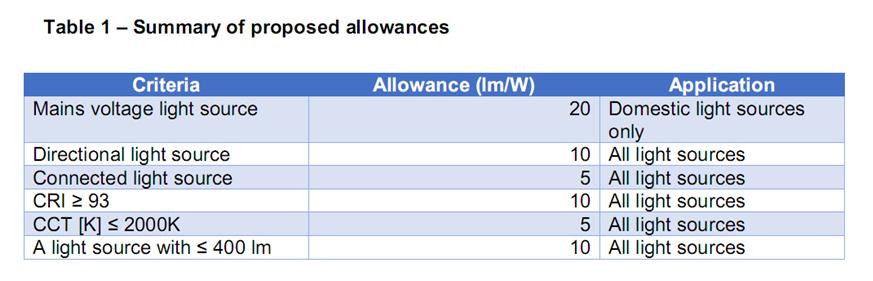
To account for the fact that certain LED lighting technologies (such as directional LEDs) and light sources with specific characteristics (e.g. low correlated colour temperature) face inherent technological barriers to increasing efficacy at the same rate as other LEDs, the policy proposal includes a series of “allowances”. The allowances will enable eligible light sources to meet slightly lower minimum luminous efficacy requirements, which will enable a greater proportion of products to remain on the market than would have been the case without them. Products that can use allowance are as follows:
We will continue to follow up the progress of British energy efficiency regulations, and provide you with an in-depth interpretation of the impact of standard updates as soon as possible, and escort your products to the British market smoothly !
BACL Service :
BACL is the Energy Star testing laboratory, certification body, and verification testing laboratory accredited by the EPA. At the same time we obtain the authorization and recognition of NVLAP (Lab Code: 200707-0), IAS (Accreditation No.: PCA-139, TL-1044, AA-797), CNAS (Registration No.: L2408, L5662, L6290, L9963, L11432, IB0343), A2LA(Certificate No.: 3297.01, 3297.02, 3297.03), and so on. Respectively have testing sites in US, Shenzhen, Dongguan and Kunshan, such places. With the ability to complete the energy efficiency aging detection of 60,000 lights at the same time. BACL is currently a large-scale energy efficiency testing laboratory in China.
We can provide you with testing and certification service, such as US Energy Star, DLC, DOE, CEC Title20, CEC Title24, LDL, FTC Label, European Union ErP, Canada NRCan, UK EST, Australia GEMS/VEET/IPART, Energy Efficiency Label ELI, Hong Kong Energy Efficiency Label and etc.