
 CN/中国
CN/中国  US/USA
  KR/Korea
  DE/Germany
  ES/Spain
 VN/Việtnam
The European Commission has carried out a preparatory study to analyse the technical, environmental and economic aspects of mobile phones, smartphones and slate tablets.
The preparatory study concluded that the scope for reducing the energy consumption of smartphones and slate tablets is substantial. It also concluded that the battery lifetime and consequently the product lifetime of smartphones and slate tablets can significantly be improved by means of an energy labelling scheme. Smartphones and slate tablets should therefore be covered by energy labelling requirements.
Finally, on 2022-09-01 The European Commission notified WTO the Draft Commission Delegated Regulation supplementing Regulation (EU) 2017/1369 of the European Parliament and of the Council with regard to the energy labelling of smartphones and slate tablets.
See the following important information:
• The final date for comments is 60 days from notification, the proposed date of adoption is 2022-12-05, and the proposed date of entry into force is 20 days from publication in the Official Journal of the EU, and it shall apply from 18 months after the entry into force of this Regulation;
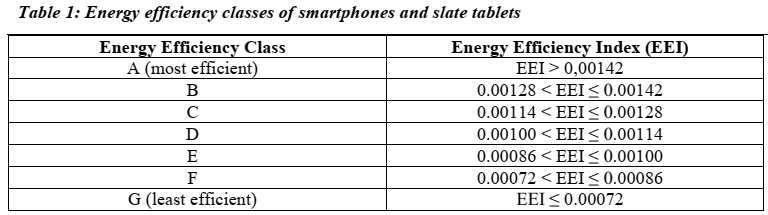
• The energy efficiency class of a smartphone or a slate tablet shall be determined on the basis of its Energy Efficiency Index (EEI) as set out in Table 1;
• The repeated free fall reliability class of a smartphone or a slate tablet shall be determined on the basis of the number of falls without defect as set out in Table 2;

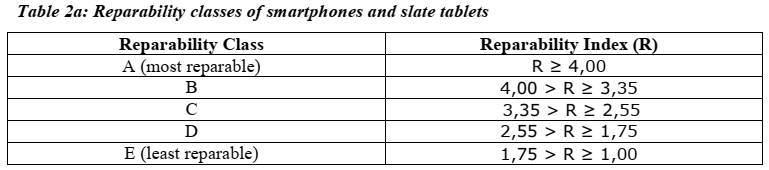
• The reparability class of a smartphone or a slate tablet shall be determined on the basis of the repairability index as set out in Table 2a;
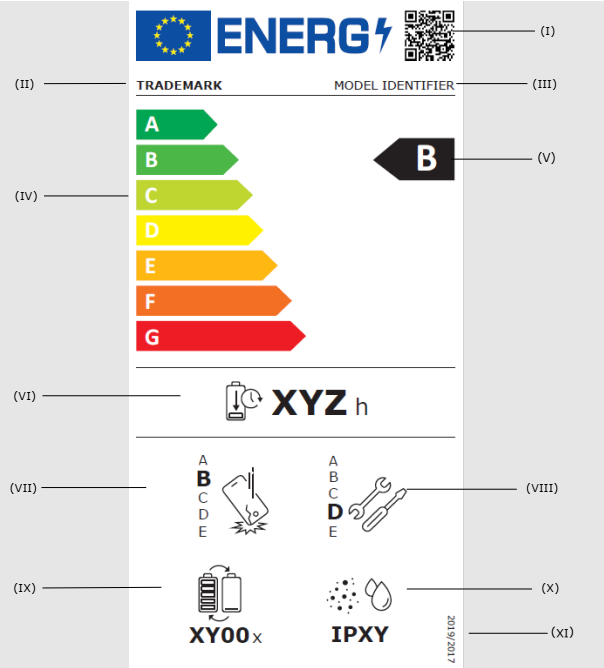
• The following information shall be included in the label for smartphones and slate tablets:
i. a QR code;
ii. the trade mark;
iii. the supplier’s model identifier;
iv. the scale of energy efficiency classes from A to G;
v. the energy efficiency class;
vi. the battery endurance per cycle;
vii. repeated free fall reliability class;
viii. reparability class;
ix. battery endurance in cycles;
x. ingress protection rating IP;
xi. the number of this Regulation.
Official website:
https://members.wto.org/crnattachments/2022/TBT/EEC/22_5918_00_e.pdf
https://members.wto.org/crnattachments/2022/TBT/EEC/22_5918_01_e.pdf
BACL Service:
BACL is the Energy Star testing laboratory, certification body, and verification testing laboratory accredited by the EPA. At the same time we obtain the authorization and recognition of NVLAP (Lab Code: 200707-0), IAS (Accreditation No.:TL-460, TL-749), CNAS (Registration No.: L2408, L5662, L6290, L9963, L11432, IB0343), A2LA(Certificate No.: 3297.01, 3297.02, 3297.03, 4821.01, 4820.01, 4324.01, 4323.01), and so on. Respectively have testing sites in US, Shenzhen, Dongguan and Kunshan, such places. With the ability to complete the energy efficiency aging detection of 60,000 lights at the same time. BACL is currently a large-scale energy efficiency testing laboratory in China.
We can provide you with testing and certification service, such as US Energy Star, DLC, DOE, CEC Title20, CEC Title24, LDL, FTC Label, European Union ErP, Canada NRCan, UK EST, Australia GEMS/VEET/IPART, Energy Efficiency Label ELI, Hong Kong Energy Efficiency Label and etc.