
 CN/中国
CN/中国  US/USA
  KR/Korea
  DE/Germany
  ES/Spain
 VN/Việtnam
Double cap Chile LEDs the Protocol released energy efficiency standards:
On June 10, 2022, Chile's official release double cap leds (replace straight tube fluorescent lamp) draft standard of energy efficiency, Protocl Number: EP No. 5/25/2:2022.
Standards of Reference:IEC 62612:2018-08Led lamps with built-inballast for general lighting services -Performance Requirements.
CHAPTER I:Scope and field of application:
This protocol establishes the Energy Efficiency certification procedure,for the electrical product Led lamp with double cap, for general lighting purposes, designed toreplace luminaires that use linear fluorescent lamps and that have the following characteristics:
• G5 and G13 bushings
• Rated power up to 125W
• Rated voltage up to 250V
• These lamps are designed to replace fluorescent lamps and do not require additional modificationto the internal wiring of the luminaire.
Exceptions:
• Led lamps for which modification of the luminaires is required.
• Luminaires in the form of LED tubes.
For purposes of evaluating the product in energy efficiency, the conditions, tests and analyzes ofthe IEC62612: 2018 standard are applied.
CHAPTER II.-Analysis And/Or Tests:
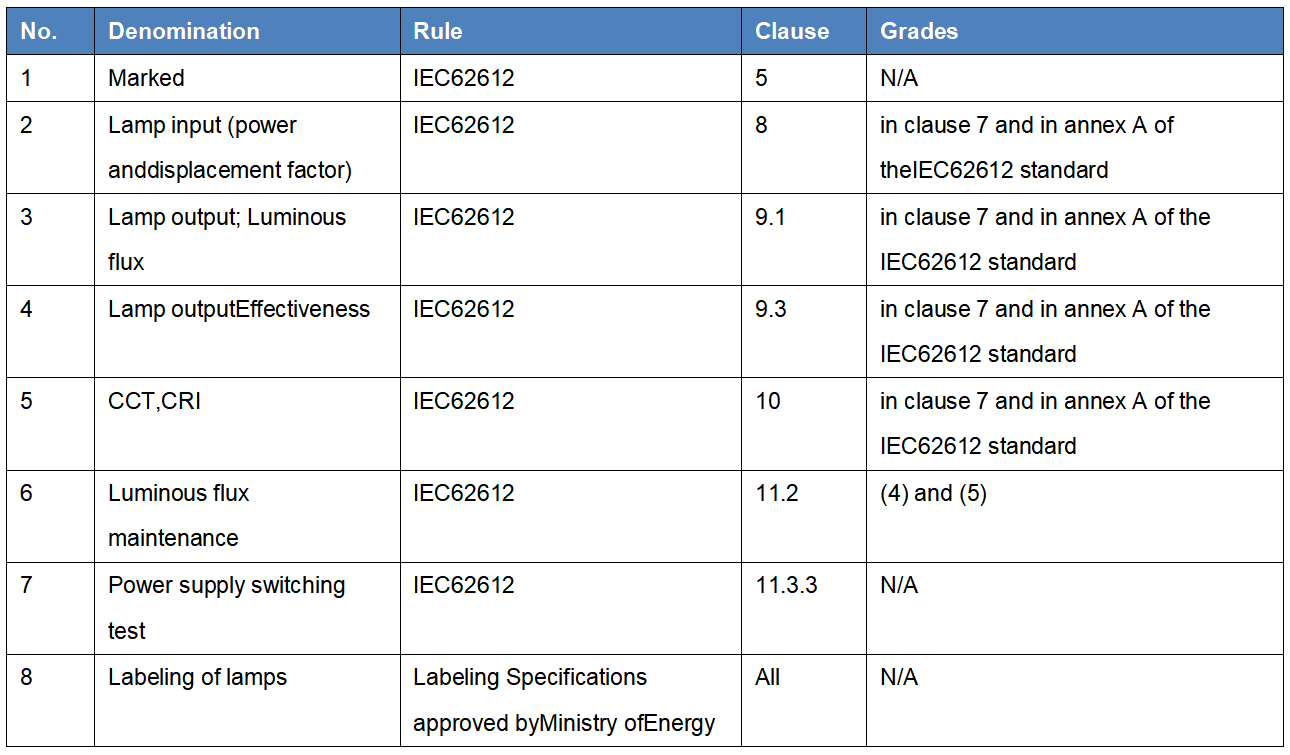
Note:
1. Individual and average power and flux tolerances must be complied with, as well as the luminous efficacy tolerance of eachlamp, which must not be less than 80% of the agreement in sub-clause 9.3.
2. In the event that the test results do not meet the tolerances indicated in the test standards and those indicated in thisprotocol, the certification body must report the results to the SEC within a maximum period of 5 business days.
3. When a product does not meet the tolerances indicated in the testing standard or indicated in this protocol, in orderto obtain the approval and/or monitoring certificate and therefore to be able to market it, the company must changethe nominal values on the packaging and/or or body of the product according to the test results.
4. The Correlated Color Temperature (CCT), Color Rendering (CRI) tests and the luminous flux maintenance test willalso be carried out at 25% of the value of the life declared by the applicant, with a maximum of 6,000 hours. Accordingto point 11.2, the minimum value of flow maintenance is 70%.
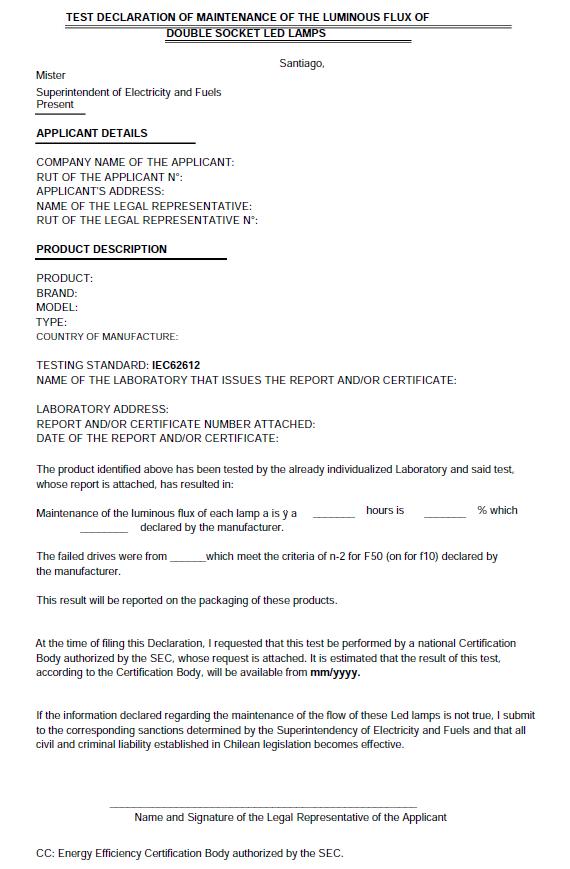
5. It will initially be accepted, while the Luminous Flux Maintenance Test is being carried out, that the applicant can obtainthe Certificate of Approval, if he meets the following condition: Submit a statement, signed by the applicant, whichmust meet the following conditions.
• The Declaration must be made and presented according to the format indicated in Chapter VI of this protocol.
• In the declaration, the nominal values of the lamp must be attached according to table 1 of the IEC 62612 standard.
• The indicated Declaration must be addressed to the Superintendency of Electricity and Fuels and must be presentedto the Certification Body.
• The Certification Body will estimate the delivery time for the result of this test, which must be indicated in thecorresponding Application for Certification of the product.
• The Certification Body must safeguard the declarations. The Certification Body must send every 4 months in Excelthe summary of the life declarations, which must be associated with the corresponding certification SEC number.
• The Certification Body must verify that the Report of this life test covers the product or products presented to becertified, and must indicate it in the item "Other Background" of the respective Certificate of Approval.
• When this test is finished, the Certification Body must issue the Luminous Flux Maintenance Test Report, carried outby an authorized Testing Laboratory, and will inform this Superintendency of the test results.
• For subsequent c ertifications, it will be a requirement to h ave t he flow maintenance test.
• The products will be tested at 220 V and 50 Hz nominal. When these nominal values are not applicable,the nominal values declared by the manufacturer or importer will be used.
CHAPTER III:Family Of Products
Those products that their origin and place of manufacture is the same and that they only have a variation in the type of bushing.
CHAPTER IV:Certification Systems
1. Type Test Followed By Regular Control Of The Products.
For Type approval, all Analyzes and/or Tests established in TABLE A of CHAPTER IIof this Protocol must be carried out.
2. Number of units
A sample must be drawn and the number of units will be in accordance with what isindicated in table 6 of IEC62612.
3. Regular Control of Products
The first Follow-up must be carried out 1 year after the Approval Certificate is issued,and its periodicity will be annual.
4. Manufacturing Approval (in Chile or abroad)
• For manufacturing approval, the following Analyzes and/or Tests must be carriedout: Power and Luminous flux.
• A sample must be drawn and the number of units will be in accordance with what isindicated in table 6 of IEC62612.
5. Certificate of Approval:
The Certification Body must issue the Certificate of Approval, using,for this purpose, the Type Test Report. Said Certificate of Approval will be valid for 1year from its date of granting.
6. Special Certification:
Those products that have been tested in accordance with the test conditions establishedin TABLE A of Chapter II of this Protocol may opt for the Special System of recognitionof foreign Certification.
• Those products that have been tested in accordance with the test conditions establishedin TABLE A of Chapter II of this Protocol may opt for the Special System of recognitionof foreign Certification.
• Verify that the product in question complies with the legal provisions on thematter (Article 22 of Supreme Decree No. 298/2005).
• The Certification Bodies must extract a sample which will be submitted to the analyzesand/or tests established in the Energy Efficiency Label.
• A sample of 3 units should be drawn
• Issuance of the Certification of Approval and regular National control.
• Once the requirements of articles 21º and 22º of DS298, of 2005, of the Ministry of
• Economy, Development and Reconstruction have been verified, the Certification.
• Body will issue a Certificate of Approval and/or Regular Control of Energy Efficiencywhose validity will be 1 year.
CHAPTER V:labeling
• For the Energy Efficiency Labeling, the "Technical Specifications for the design of theEfficiency Label" must be used, approved by the Ministry of Energy.
• Said Label will be a necessary condition to obtain the Energy Efficiency Approval Certificate.
• It must be verified that the information in the Label fields is obtained in accordance with thisProtocol.
CHAPTER VI:Additional Requirement
Before issuing the Energy Efficiency Approval Certificate, the Certification Bodies must verifythat the product has the respective Safety Approval Certificate.
Test Declaration Of Maintenance Of The Luminous Flux:
BACL Service:
BACL is the Energy Star testing laboratory, certification body, and verification testing laboratory accredited by the EPA. At the same time we obtain the authorization and recognition of NVLAP (Lab Code: 200707-0), IAS (Accreditation No.:TL-460, TL-749), CNAS (Registration No.: L2408, L5662, L6290, L9963, L11432, IB0343), A2LA(Certificate No.: 3297.01, 3297.02, 3297.03, 4821.01, 4820.01, 4324.01, 4323.01), and so on. Respectively have testing sites in US, Shenzhen, Dongguan and Kunshan, such places. With the ability to complete the energy efficiency aging detection of 60,000 lights at the same time. BACL is currently a large-scale energy efficiency testing laboratory in China.
We can provide you with testing and certification service, such as US Energy Star, DLC, DOE, CEC Title20, CEC Title24, LDL, FTC Label, European Union ErP, Canada NRCan, UK EST, Australia GEMS/VEET/IPART, Energy Efficiency Label ELI, Hong Kong Energy Efficiency Label and etc.