 CN/中国
CN/中国  US/USA
  KR/Korea
  DE/Germany
  ES/Spain
 VN/Việtnam
May 9, 2022 DOE issues new regulations for General Service Lamps(GSLs):
On May 9, 2022, DOE officially published two new energy regulations for GSL:
• DOE New Regulation I :EERE-2021-BT-STD-0012-0022
• DOE New Regulation II :EERE-2021-BT-STD-0005-0070
DOE Effective date of new Regulations for GSLs:
• DOENew Regulation I:It will take effect on July 8, 2022. The main purpose of the new regulation is to reactivate the definition requirements for GSL and GSIL, which were formally included in the final regulation in January 2017.
• DOENew Regulation II:As a supplementary information limit requirement, all GSLs are required to have a light efficiency of not less than 45 lm/w, and GSLs less than 45 lm/w will be prohibited from entering the U.S. market. The regulation will take effect on July 25, 2022.
General Service Lamp(GSL)is defined as follows:
GSLs includes Lamps that meet the following conditions:
1. Has an ANSI base;
2. A voltage of 12 volts or 24 volts, at orbetween 100 to 130 volts, at or between220 to 240 volts, or of 277 volts forintegrated lamps, or is able to operate at anyvoltage for non-integrated lamps.
3. has an initiallumen output of greater than or equal to310 lumens (or 232 lumens for modifiedspectrum general service incandescentlamps) and less than or equal to 3,300lumens;
4. Is not a light fixture; is not anLED downlight retrofit kit; and is usedin general lighting applications;
5. Generalservicelamps include, but are notlimited to, general service incandescentlamps, compact fluorescent lamps,general service light-emitting diodelamps, and general service organic lightemitting diode lamps.
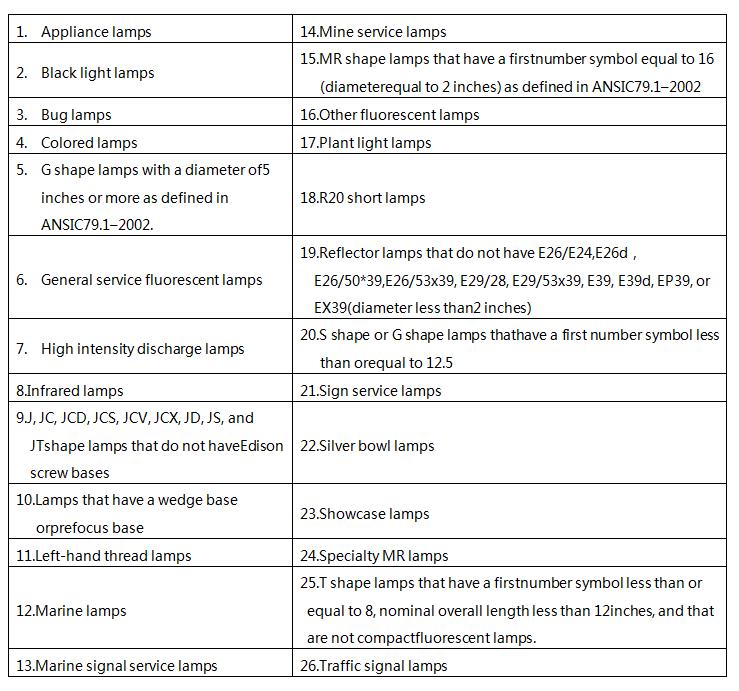
General servicelamps do not include:
General service incandescent lamp(GSIL)is defined as follows:
GSILincludes Lamps that meet the following conditions:
1. A standard incandescent orhalogen type lamp;
2. Has amedium screw base;;
3. Has a lumen rangeof not less than 310 lumens and notmore than 2,600 lumens or, in the case
of a modified spectrum lamp, not lessthan 232 lumens and not more than1,950 lumens;
4. Is capable of beingoperated at a voltage range at leastpartially within 110 and 130 volts。
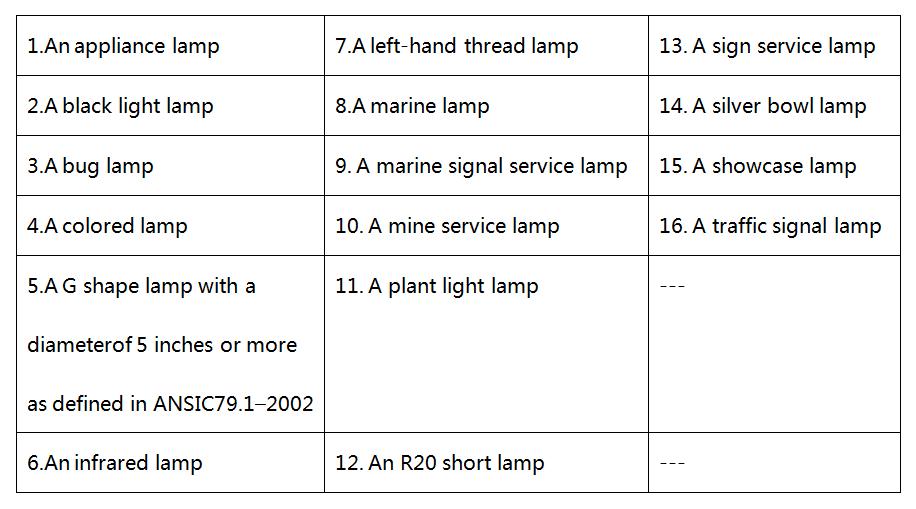
GSILdo not include:
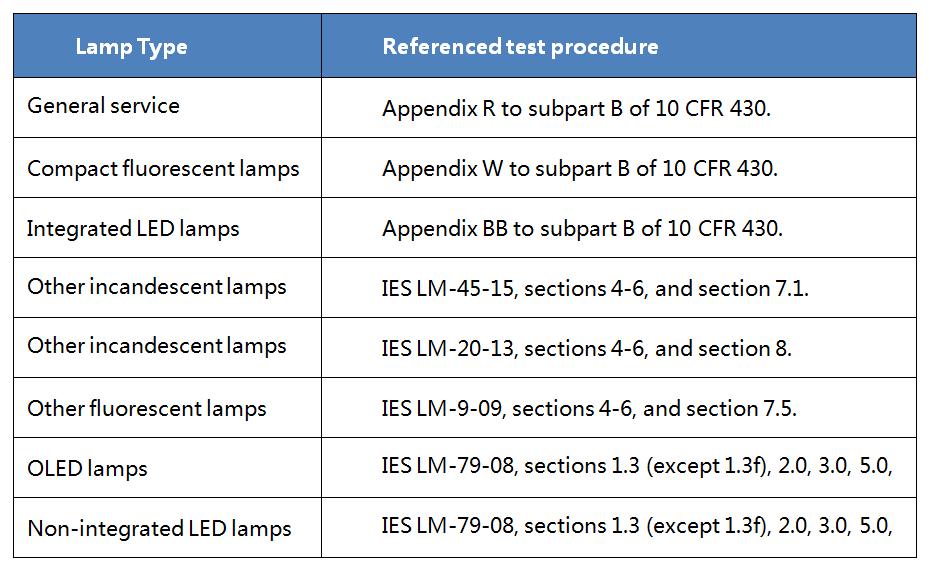
The test method standards applicable to GSLs are as follows:
BACLexpert's advice:
The expanded definition of GSL issued by DOE means that all common lighting bulbs currently on the market will be required to meet the DOE testing requirements and provide proof of conformity to DOE energy conservation program. Each manufacturer should complete DOE certification of GSL as soon as possible to avoid the subsequent impact of the new regulations on the sales of products in the US market. If you have any questions about US DOE certification, please feel free to contact us, we will provide you with a full set of US lighting product certification package services, to help you export smoothly to the North American Market!
BACL Service:
BACL is the Energy Star testing laboratory, certification body, and verification testing laboratory accredited by the EPA. At the same time we obtain the authorization and recognition of NVLAP (Lab Code: 200707-0), IAS (Accreditation No.:TL-460, TL-749), CNAS (Registration No.: L2408, L5662, L6290, L9963, L11432, IB0343), A2LA(Certificate No.: 3297.01, 3297.02, 3297.03, 4821.01, 4820.01, 4324.01, 4323.01), and so on. Respectively have testing sites in US, Shenzhen, Dongguan and Kunshan, such places. With the ability to complete the energy efficiency aging detection of 60,000 lights at the same time. BACL is currently a large-scale energy efficiency testing laboratory in China.
We can provide you with testing and certification service, such as US Energy Star, DLC, DOE, CEC Title20, CEC Title24, LDL, FTC Label, European Union ErP, Canada NRCan, UK EST, Australia GEMS/VEET/IPART, Energy Efficiency Label ELI, Hong Kong Energy Efficiency Label and etc.