
 CN/中国
CN/中国  US/USA
  KR/Korea
  DE/Germany
  ES/Spain
 VN/Việtnam
Australian Toy Market Overview
Australia is a country with a federal system, called the Commonwealth of Australia, consisting of 6 states and 2 territories. In Australia, the federal government and each state/territory have legislative, judicial and executive powers. Where federal regulations are inconsistent with local/state regulations, the federal regulations shall prevail. Many toy products in Australia are imported from Asian countries, including China, Malaysia, Thailand, etc., and most of the toy products are from China.
Australian Toy Market Regulator
Australia's toy market supervision is mainly by the Australian Competition and Consumer Commission, referred to as ACCC. ACCC is an independent federal statutory body and a member of the Australian Standards organization. It is responsible for the implementation of the Competition and Consumer Act and other acts, the implementation of mandatory toy-related standards, and the toy-related bans announced by the act.
Australian Toy-related Mandatory Standards and Notices
1. Consumer Goods (Aquatic Toys) Safety Standard 2020 sets out the mandatory requirements for aquatic toys. These requirements are intended to reduce the risk of serious injury or death to children from drowning. An aquatic toy must comply with the relevant sections of one of the following standards:
a) Australian/New Zealand Standard AS/NZS ISO 8124.1:2019 Safety of toys Part 1: Safety aspects related to mechanical and physical properties.
b) International Standard ISO 8124-1:2018 Safety of toys - Part 1: Safety aspects related to mechanical and physical properties.
(Note:Up to 12 June 2022, suppliers have the option to comply with the requirements from either the Consumer Goods (Aquatic Toys) Safety Standard 2020 or the Consumer Protection Notice No. 2 of 2009 (Consumer Product Safety Standard for Flotation Toys and Aquatic Toys). From 13 June 2022, suppliers must only comply with the requirements in the Consumer Goods (Aquatic Toys) Safety Standard 2020.)
2.Consumer Protection Notice No. 14 of 2003, as amended by Consumer Protection No. 1 of 2005 sets out the requirements for toys for children up to and including 36 months. The mandatory standard is based on certain sections of the voluntary Australian/New Zealand Standard AS/NZS ISO 8124.1:2002 'Safety of toys Part 1: Safety aspects related to mechanical and physical properties'.
3.Consumer Protection Notice No. 1 of 2009 sets out the mandatory requirements for toys and finger paints. The mandatory standard is based on certain sections of the voluntary Australian/New Zealand Standard AS/NZS 8124.3:2003 'Safety of toys, Part 3—Migration of certain elements'.
The table below outlines the maximum acceptable levels of migratable lead and other elements in children's toys and finger paints (mg/kg):

4. Consumer Goods (Toys Containing Magnets) Safety Standard 2020 sets out the mandatory requirements for children’s toys containing magnets. These requirements are intended to reduce the risk of serious injury or death to children from swallowing small hazardous magnets. Toys containing magnets must comply with the relevant sections of one of the following standards:
a) Australian/New Zealand Standard AS/NZS ISO 8124.1:2019 Safety of toys Part 1: Safety aspects related to mechanical and physical properties.
b) European Standard EN 71-1:2014+A1:2018 Safety of toys - Part 1: Mechanical and physical properties.
c) International Standard ISO 8124-1:2018 Safety of toys – Part 1: Safety aspects related to mechanical and physical properties.
d) US Standard ASTM F963 - 17 Standard Consumer Safety Specification for Toy Safety.
5. Consumer Goods (Projectile Toys) Safety Standard 2020 sets out the mandatory requirements for projectile toys. These requirements are intended to reduce the risk of choking, eye injuries and flesh wounds during play. A projectile toy must comply with the relevant sections in one of the following four standards:
a) Australian/New Zealand Standard AS/NZS 8124.1:2019 - Safety of Toys - Part 1: Safety Aspects Related to Mechanical and Physical Properties (including amendments 1 and 2).
b) European Standard EN 71-1:2014+A1:2018 Safety of Toys - Part 1: Mechanical and Physical Properties.
c) International Standard ISO 8124.1:2018 Safety of Toys - Part 1: Safety Aspects Related to Mechanical and Physical Properties (including amendments 1 and 2).
d) American Society for Testing and Materials Standard ASTM F963-17 Standard Consumer Safety Application for Toy Safety.
(Note:Up to 11 June 2022, suppliers have the option to comply with the requirements from either the Consumer Goods (Projectile Toys) Safety Standard 2020 or Consumer Protection Notice No. 16 of 2010 (Consumer Product Safety Standard for Children's Projectile Toys). From 12 June 2022, suppliers must only comply with the requirements in the Consumer Goods (Projectile Toys) Safety Standard 2020.)
6.Consumer Goods (Products Containing Button/Coin Batteries) Safety Standard 2020 defines the safety requirements for all consumer goods containing button/coin batteries, including storage containers and organisers. It also applies to accessories of consumer goods, such as remote controls, that contain button/coin batteries. From 22 June 2022, fines and penalties may apply if you supply button/coin batteries, or products containing them, that don’t comply with these standards.
7.Consumer Goods (Products Containing Button/Coin Batteries) Information Standard 2020 defines safety warnings and information for consumer goods that contain button/coin batteries, including storage cases and organisers. It also applies to accessories of consumer goods, such as remote controls, that contain button/coin batteries. From 22 June 2022, fines and penalties may apply if you supply button/coin batteries, or products containing them, that don’t comply with these standards.
Australian Toy-related Bans
1. Consumer Protection Notice No. 11 of 2011 sets out the ban requirements for DEHP in children's plastic items. This ban prohibits supply of certain plastic products that:
a) are intended for use by children up to and including 36 months of age
b) contain or have an accessible component containing more than 1 per cent by weight of DEHP
c) are products that children up to and including 36 months of age can readily chew and/or suck
This ban only applies to toys, childcare articles, and eating vessels and utensils that meet each of the above criteria. DEHP may cause harm to the reproductive system and harm the health of children.
2.Consumer Protection Notice No. 13 of 2011 sets out the ban requirements for toys containing beads. There is a permanent ban on the sale of inflatable toys, novelties and furniture that have loose beads or small particles inside the product, due to the risk of choking or suffocation for young children.
3.Consumer Protection Notice No. 20 of 2011 sets out the ban requirements for Yo-Yo water balls. The rope on the Yo-Yo water balls may be more than 1 meter in length after being stretched, and it will be entangled around the child’s neck and cause suffocation; in addition, when the Yo-Yo water ball is damaged, the liquid flowing out of it may irritate the skin or be ingested and endanger health.
4.Consumer Protection Notice No. 18 of 2011 sets out the ban requirements for novelty cigarette lighters. Toy-like novelty cigarette lighters designed to produce a flame that sets cigarettes or other combustible materials alight are banned from supply in Australia. Because children will mistake such products as toys, they will cause serious burns if they catch fire while playing.
5.Consumer Protection Notice No. 5 of 2012 sets out the ban requirements for small high powered magnets. If a child swallows more than one small high-power magnet, these magnets will stick together and pass through the child’s intestinal wall or other digestive tissues, which may cause internal injuries and even death. Magnets may pose a choking hazard to young children (small parts).
Voluntary Standards for Australian Toys
In terms of voluntary standards for toys, Australia basically adopts the international standards ISO 8124 series standards and the European Union EN71 series standards. The main standards are shown in the following table:
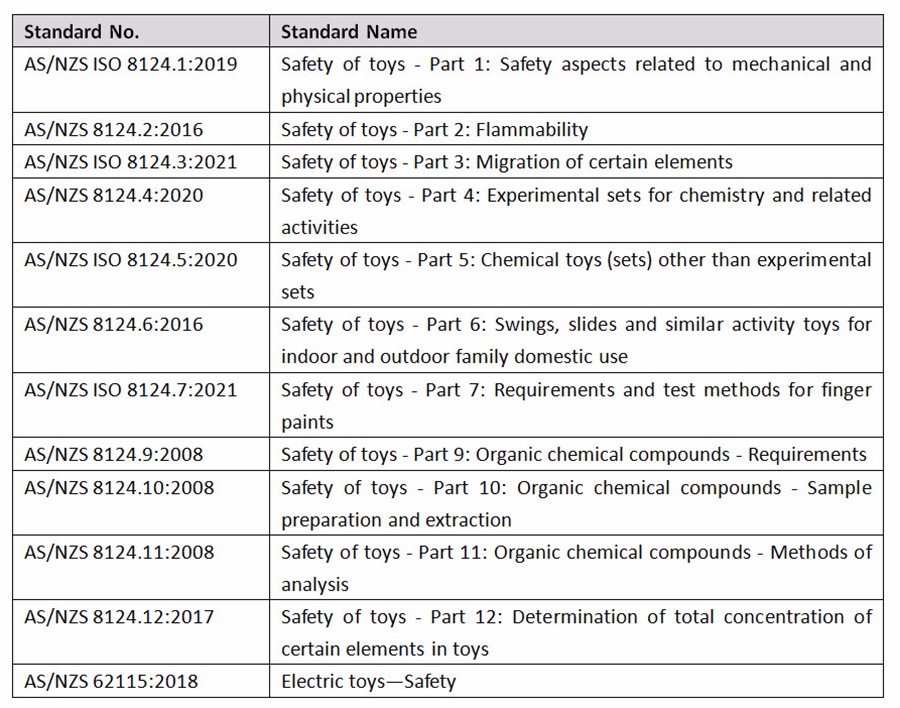
The above standards are adopted voluntarily. It is worth noting that the mandatory standards and notification-related requirements related to Australian toys are mandatory.
Conformity Assessment Procedures for Australian Toys
When toys enter the Australian market, they need to be tested according to the requirements of the above-mentioned regulations and standards, and meet their requirements; for some electric toys and wireless remote control toys, mandatory certifications such as electronic and electrical product safety and electromagnetic compatibility are required before they can be marketed.
BACL reminds you
For children's toy products exported to the Australian market, relevant tests should be completed in accordance with Australian Safety Requirements for children's toys to ensure the safe and smooth export of products. BACL Toy Lab has been accredited by ISO/IEC 17025 by multinational accreditation bodies, which can help your children's toy products enter the Australian market smoothly.
BACL Service:
BACL, with its headquarter in Silicon Valley, it is a global and comprehensive international third-party testing and certification body. Currently we have physical and chemical testing labs in the United States, Shenzhen, Dongguan, Xiamen and other places, and we have accredited the certifications by UKAS (Lab No.: 7827), CNAS (Registration No.: L2408, L5662, L6290, L9963, L11432, IB0343), CPSC (Lab ID: 1112, 1415, 1647), CMA (No.: 2016192126Z, 2015192413Z) and other authorities. We offer a full range of testing services which cover footwear, toys, textile, clothing, leather, jewelry, groceries, food contact materials, cosmetics and electrical and electronic products, etc. We can help enterprises to complete the precise control of whole industry chain from raw materials to the finished products.